
Morning Routines
Why the Snooze Button Feels So Good (and What It Costs)
4 September 2026 · 11 min read
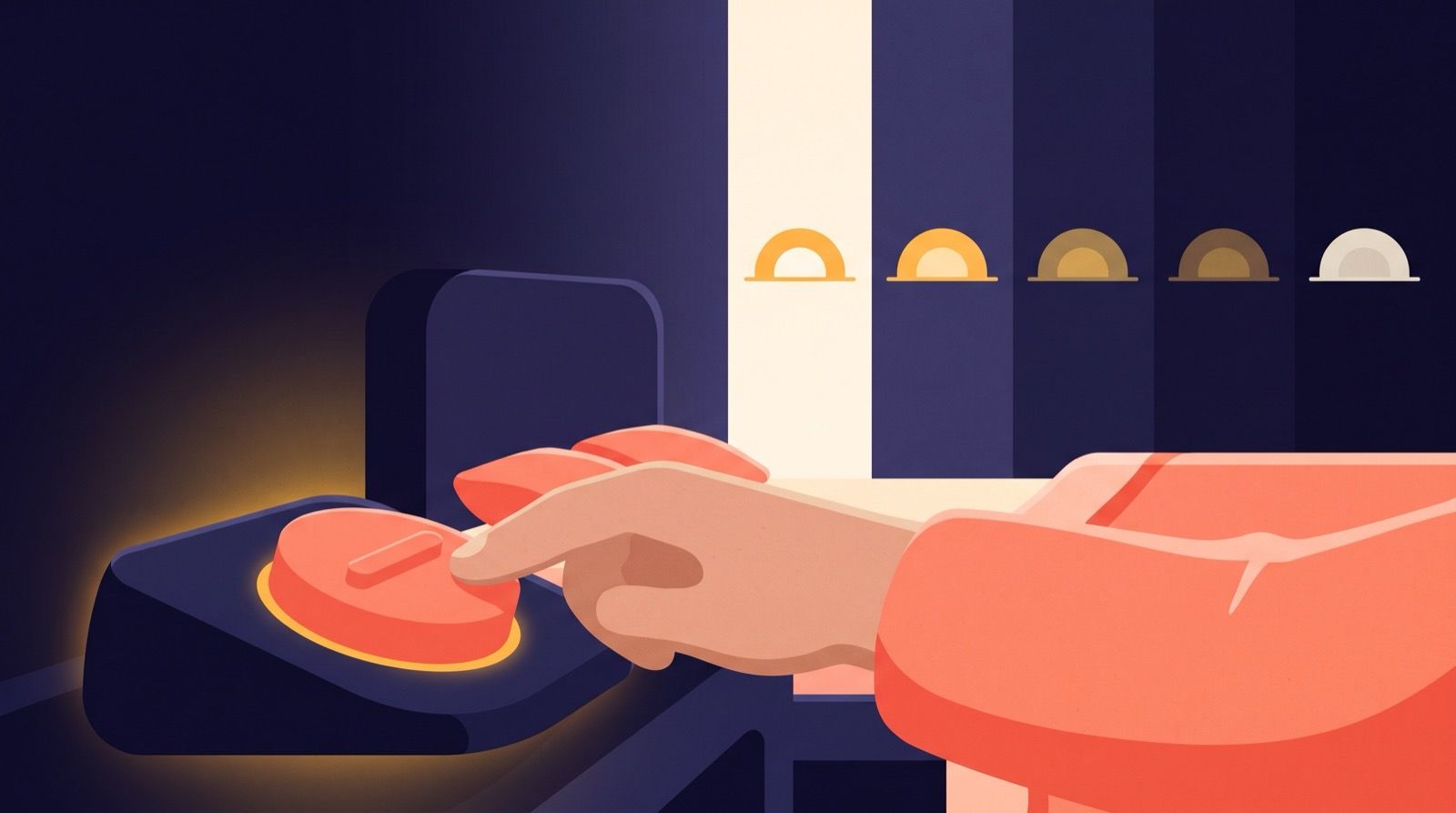
You did not decide to snooze. That is the part worth sitting with.
At 6:00 the noise started. Somewhere in the next second and a half, a hand you were not supervising found the largest soft target on the screen, and the noise stopped, and something in your chest unclenched. At 6:11 you were awake for real, mildly annoyed, and slightly behind. You could not have described the intervening decision, because there was not one. There was a stimulus and a response, and the response was faster than you.
This is the most common human behaviour nobody has a good story about. Here is one, along with an honest account of where the evidence runs out, because on this question the honest version is more interesting than the sermon.
Eleven minutes, 2.4 times, most mornings
Start with scale. Robbins and colleagues, writing in Scientific Reports in 2025, pulled more than three million nights from a global sample of sleep-tracking app users. More than half of all sleep sessions, 55.6 percent, ended with a snooze alarm. When people snoozed, they pressed on average 2.4 times and spent an average of 10.8 minutes doing it.
That is not a fringe habit with a self-control problem attached. That is the modal way human beings currently get out of bed.
Mattingly and colleagues, in Sleep in 2022, found much the same in a smaller, better-characterised sample: 57 percent of 450 participants snoozed, with younger people, women, evening chronotypes and those with more disturbed sleep all likelier. Robbins found something similar and slightly sharper: people who went to bed later than usual snoozed more, and people who went to bed earlier snoozed less.
Hold onto that last finding. It turns out to be the whole argument.
Why the button wins
The tidy explanation you will read everywhere is that snoozing is a dopamine hit. Nobody has put a habitual snoozer in a scanner at 6:04 and measured anything of the kind. The reward-chemistry framing is a metaphor that got promoted to a finding.
The unglamorous explanation is better supported and, annoyingly, more useful.
First, the timing. Sleep inertia is the transitional state of lowered arousal right after waking, and it reliably degrades performance for a while afterwards. Tassi and Muzet’s review in Sleep Medicine Reviews remains the standard reference, and it flags the detail that matters here: the sleep stage you are yanked out of changes how bad it is. Abrupt awakening from slow-wave sleep produces more inertia than waking from stage 1 or 2, with REM sitting in between. Meanwhile, Hilditch and McHill’s 2019 review notes that prefrontal regions, the executive ones, take longer to come back online than the rest of the brain.
So the first decision of your day is handed to the last system to arrive at work. That is not a metaphor. It is a scheduling problem.
Second, the reinforcement. Pressing snooze removes an unpleasant noise instantly, at zero cost, with a hand that barely has to travel. In learning terms that is about as clean a negative reinforcement loop as you can build, and it runs a few hundred times a year. Wood and Rünger’s review of habit in the Annual Review of Psychology describes what happens to a response repeated that often in a stable context: it stops being a choice and becomes a cued action, retrieved automatically, largely independent of whatever you intended last night. You are not weighing anything at 6:00. You are executing.
Third, the sleep is real. This is the bit people get wrong in the other direction, and it is where the research turns surprising.
The research is kinder to snoozing than the headlines
Here is where the standard morning-routine article usually pivots to scolding. The evidence does not support the pivot.
Sundelin, Landry and Axelsson published the best-controlled test we have in the Journal of Sleep Research in 2024, across two studies. Study 1 surveyed 1,732 people and confirmed the demographics: snoozing is widespread, concentrated in younger people and later chronotypes, and associated with morning drowsiness and shorter sleep. Study 2 was the interesting one. Thirty-one habitual snoozers slept in a lab under polysomnography, and the researchers compared 30 minutes of snoozing against a single abrupt awakening.
Thirty minutes of snoozing improved or did not affect cognitive performance immediately on rising. It cost about six minutes of actual sleep. It produced no clear effect on the cortisol awakening response, on morning sleepiness, on mood, or on overnight sleep architecture. And it prevented awakenings from slow-wave sleep, which, given what Tassi and Muzet said about waking from N3, is a plausible mechanism for why it might feel better rather than worse.
Bayes factors varied, the cognitive sample was 31 people, all of them were already habitual snoozers, and nobody has shown this generalises to someone who currently wakes at the first alarm. But the direction of the finding is not ambiguous, and it is not the direction the internet told you.
The rest of the physiological case is similarly thin. Mattingly’s snoozers had elevated resting heart rates and lighter sleep in the period before waking, which is worth knowing. They did not sleep less than non-snoozers, did not report more sleepiness, and did not nap more. The cortisol awakening response, that large burst of cortisol across the first 30 to 45 minutes after waking, is often invoked in snooze explainers as something you are disrupting. Sundelin measured it directly and found no clear effect.
One more argument people reach for: sleep fragmentation. Bonnet and Arand’s review established that fragmented sleep produces a symptom profile resembling outright sleep deprivation: more objective sleepiness, degraded reaction time and short-term memory, worse mood. All true. But those studies fragmented entire nights with repeated experimental arousals. Stretching that to two alarm presses in the last ten minutes of an eight-hour night is an extrapolation, not a finding. The “you are shredding your REM” line has a real fact underneath it, since REM periods do lengthen across the night and the final cycle can run up to an hour, but Sundelin’s polysomnography found no clear disruption to architecture. The mechanism is plausible. The measured harm is not.
The evidence here is thinner than the headlines suggest. Say it out loud, and the real cost becomes easier to see.
So what does it actually cost?
Three things, none of which are the ones you have been sold.
It costs the time, honestly counted. At 10.8 minutes on 55 percent of mornings, that is roughly two and a half hours a month spent in a state that is neither rest nor waking. If you would not schedule it, you should probably not spend it.
It costs you the diagnosis. This is the big one. Robbins found that snoozing tracks with going to bed later than usual. Mattingly found it tracks with disturbed sleep and evening chronotype. Snoozing is mostly a symptom, and it is a good one, in the clinical sense: a legible daily signal that you are either short on sleep or waking at the wrong point in your own circadian phase. Treating the button as the problem is like treating a cough. If you snooze every day, the finding is not that you lack discipline. The finding is that your alarm is set earlier than your body is currently organised to wake, and the fix lives at the other end of the day. We wrote about the mechanics of that in Revenge Bedtime Procrastination.
It costs you an unguarded decision, repeatedly. Sundelin’s participants did fine on cognitive tests after 30 minutes of snoozing. But a cognitive test is not the same as the choices that actually happen in the snooze window: whether to skip the shower, whether to answer that message from bed, whether the run is happening. Those get made by a prefrontal cortex that Hilditch and McHill would tell you is the last one back on duty, and they get made two or three times per morning rather than once. The problem was never the ten minutes of light sleep. It is that the ten minutes contain three re-runs of a decision you already made last night, adjudicated by the least qualified version of you.
Four things that actually help
- Move the alarm to where the evidence points. If you snooze every morning, try setting the alarm 20 minutes later for a week and going to bed 20 minutes earlier. Robbins’ bedtime finding suggests this does more than any amount of resolve. It is unglamorous and it usually works.
- Decide the number the night before. A bounded snooze that you chose while awake is a completely different object from an open-ended one you did not. Two is a policy. “Until I feel like it” is a habit loop with the brakes off.
- Protect the first half hour rather than fighting it. Tassi and Muzet put the usual duration of inertia under about 30 minutes in the absence of serious sleep loss. Do not schedule anything that requires judgment inside it. The deeper mechanics are in Sleep Inertia: Why You Wake Up Groggy.
- Add friction, not volume. A louder alarm gets dismissed by the same automatic hand. Something you can visibly fail at does not. That distinction is the subject of Math Problems at 6 AM, and it is the one design principle here with a real mechanism behind it.
Where WakeSharp fits, and where it does not
The problem this article describes is specific: snoozing is a fast, automatic, zero-effort response to a cue, and its cost is repetition rather than the sleep itself. So the useful intervention is not to abolish snoozing. It is to make the number finite and to make each press cost something you can feel.
In WakeSharp, snoozing is a policy you set when you build the alarm, not a rule imposed on you. Off means the button is not there. Standard gives you two five-minute snoozes and takes five Sharpness points off each time you use one. Tighten keeps the snoozes but shortens the gaps: ten minutes, then five, then two, so the runway visibly runs out. Those three are free. A custom policy is a Plus feature.
The Sharpness penalty is not punishment, it is a price tag. A press that costs nothing is invisible. A press that costs five points shows up in the score, which compares this morning against your own baseline rather than an idealised stranger’s.
Now the limits, which matter more than the pitch.
The system Stop button on your phone always works, on both platforms, and we are not going to design around pretending otherwise. Strict Mode books four re-rings in advance, at 45 seconds and then 4, 8 and 12 minutes, where supported. No alarm app can guarantee it will wake you. For anything genuinely consequential, keep a second, independent alarm on a separate device.
And the honest scientific limit: nothing above proves that capping your snoozes improves your cognition. Sundelin’s data suggest a bounded snooze is not harming it. A snooze policy converts an automatic response into a finite, visible one, which is a claim about interface design rather than neuroscience. That is a smaller claim than most alarm apps make, and it happens to be true.
Your alarm rings free, forever, and Plus is ad-free. Mind Games and Photo Proof are the free missions, and the Plus missions gate when you create an alarm, never when one rings.
FAQ
Why is snoozing bad for you?
Less bad than you have been told. The best controlled study, Sundelin and colleagues in 2024, found that 30 minutes of snoozing improved or did not affect cognition in habitual snoozers, cost about six minutes of sleep, and did not disturb sleep architecture or the cortisol awakening response. The real costs are the time, the fact that heavy snoozing signals insufficient or mistimed sleep, and the repeated handing of decisions to a brain that has not finished starting up.
How many times do people hit snooze on average?
In Robbins and colleagues’ 2025 analysis of over three million nights, 55.6 percent of sleep sessions ended with a snooze alarm, and those who snoozed pressed 2.4 times on average, spending 10.8 minutes doing it. Roughly 57 percent of people snooze at all, which matches Mattingly’s independent 2022 estimate.
Does hitting snooze ruin your REM sleep?
The premise is half right. REM periods genuinely do get longer as the night goes on, so morning sleep is REM-rich. But the polysomnography in Sundelin’s study found no clear effect of a 30-minute snooze period on overnight sleep architecture. The mechanism sounds convincing; the measurement has not backed it up.
How do I stop snoozing?
Treat it as a timing problem first. Snoozing tracks strongly with later-than-usual bedtimes and evening chronotypes, so shifting your alarm later or your bedtime earlier addresses the cause. Then set a fixed number of snoozes while you are awake enough to mean it, and put something you can fail at between yourself and the off switch. Willpower at 6:00 is not a resource you have.
- snooze
- sleep-inertia
- morning-routine