
Sleep Science
Revenge Bedtime Procrastination: Why You Sabotage Tomorrow Every Night
28 August 2026 · 12 min read
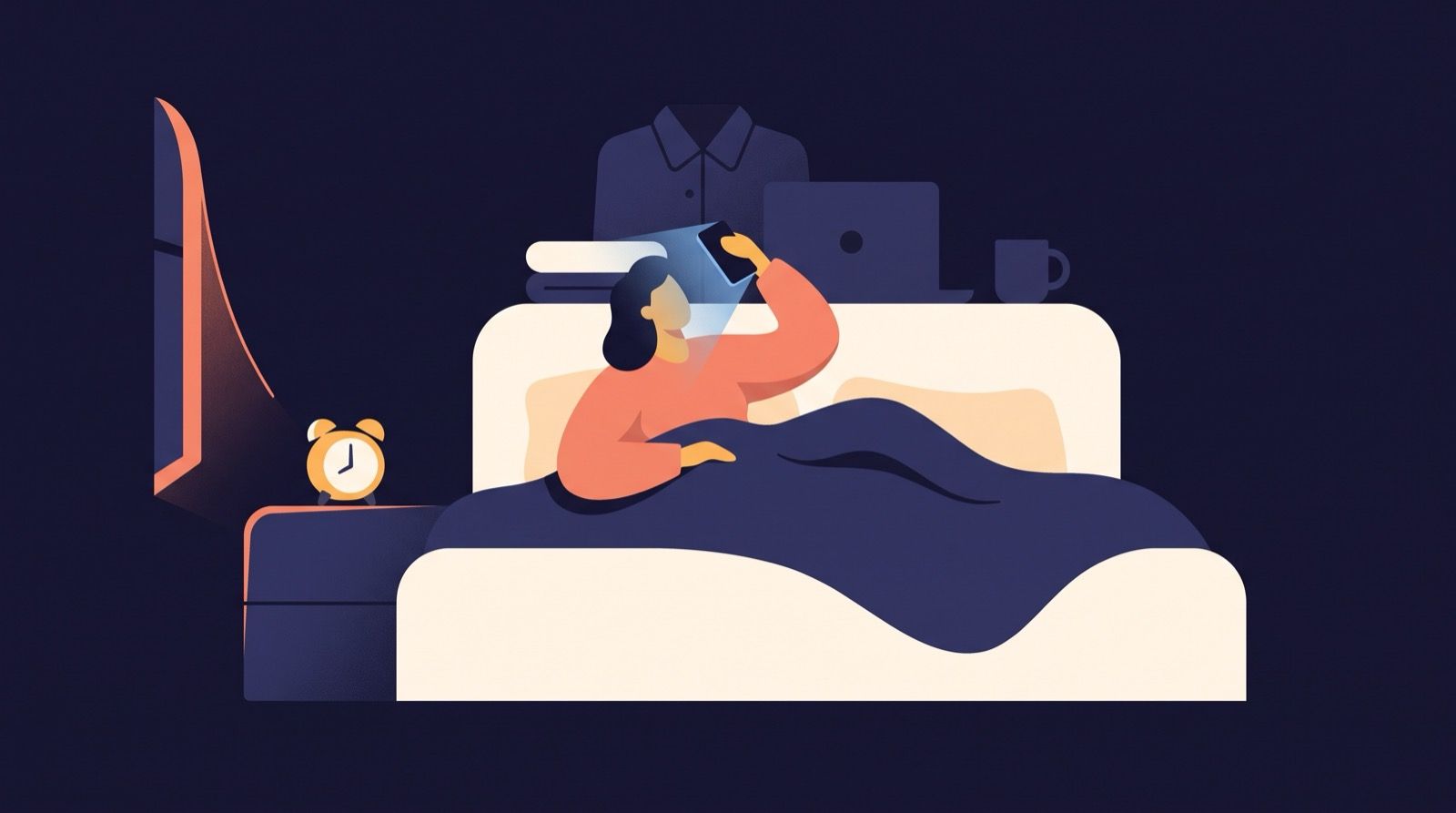
It is 12:40 AM. You have to be functional at nine. You have been holding your phone at the same angle long enough that your wrist has gone numb, and you have not actually enjoyed anything on the screen for the last twenty minutes. You know precisely what this costs. You keep going anyway.
Then comes the part that stings. You finally put the phone down, and instead of relief you feel cheated, as though the evening ended before your turn came around.
That feeling is the whole phenomenon in one sentence. What happens at midnight is not really about sleep. It is about the day.
The phrase came from a country working 996
The English term is a translation. On Chinese social media, people had been describing 报复性熬夜, bàofùxìng áoyè, roughly “retaliatory staying up late,” as a response to the 996 schedule: nine in the morning to nine at night, six days a week. It crossed into English in 2020, and the Sleep Foundation’s summary captures the logic behind it neatly: people with little control over their daytime hours refuse to sleep early in order to claim back some sense of freedom at night.
The revenge, notice, is not aimed at anyone. There is no boss to punish at 1 AM. The only person on the receiving end is the one who has to get up.
It is a self-regulation problem, but not the one you assume
Researchers had a name for the underlying behavior before the internet gave it a better one. In 2014, Floor Kroese and colleagues at Utrecht introduced bedtime procrastination: failing to go to bed at the intended time when nothing external is stopping you (Kroese et al., Frontiers in Psychology, 2014). No screaming baby, no second shift, no deadline. Just a person and a decision they keep declining to make.
It turned out not to be a fringe habit. In a representative sample of 2,431 Dutch adults, the team found that general self-regulation predicted how much insufficient sleep people reported, and that bedtime procrastination was the path connecting the two (Kroese et al., Journal of Health Psychology, 2016).
Here is where the easy story usually starts, and where it deserves to be interrupted. The pop version says willpower is a battery, your day drains it, and by 11 PM there is nothing left to spend on going to bed. It is a satisfying story. The evidence for it is shakier than its popularity suggests. The ego-depletion effect that story rests on was tested by 23 laboratories with 2,141 participants in a preregistered replication, and the effect did not show up (Hagger et al., Perspectives on Psychological Science, 2016).
A daily diary study of employees found something even more awkward for the battery model. On evenings when people had fewer self-regulatory resources available, they procrastinated bedtime less, not more. What did predict late nights was chronotype: evening types delayed bedtime more on workdays (Kühnel, Syrek & Dreher, Frontiers in Psychology, 2018). The authors read this as a collision between biological sleep timing and the schedule society hands you, which is not the same thing as a character flaw.
So if it is not a drained battery, what is it?
What you are actually buying at 1 AM
The most useful study on this asked people directly. Nauts and colleagues interviewed 17 frequent bedtime procrastinators and found three distinct varieties hiding under one label (Nauts et al., Behavioral Sleep Medicine, 2019):
- Deliberate procrastination. Staying up on purpose because you felt you deserved time for yourself.
- Mindless procrastination. Losing track of time inside an activity that had no natural ending.
- Strategic delay. Staying up because you believe going to bed earlier means lying awake, which points at insomnia rather than procrastination.
Those three want three different interventions, and lumping them together is why generic sleep advice bounces off. But the first one is the one the word “revenge” was invented for, and it has a coherent psychology behind it.
Self-determination theory, developed over decades by Edward Deci and Richard Ryan, argues that humans have three basic psychological needs: competence, relatedness, and autonomy, the sense that your behavior is chosen rather than compelled. Thwart them and motivation and wellbeing degrade (Ryan & Deci, American Psychologist, 2000).
Now audit a normal weekday. Meetings you did not schedule. A commute you did not design. Messages that arrive whether or not you want them. Dinner, dishes, laundry, a child, a parent. By the time the house goes quiet, you may not have made one unforced choice all day. Then you find an hour with nothing scheduled in it, and it is the only hour that is unambiguously yours.
Staying up is not irrational under those conditions. It is the cheapest available autonomy. You are not choosing scrolling over sleeping; you are choosing being a person with choices over being a unit on tomorrow’s schedule. That trade makes complete sense at midnight and no sense at all at 7 AM, which is exactly why it repeats.
Worth being honest about the evidence here: the autonomy framing is a strong and well-supported theory of human motivation, and it fits this behavior unusually well, but the specific causal chain from a low-autonomy day to a delayed bedtime is not something a single clean experiment has nailed down. Treat it as a good map, not a proof.
The bill arrives, and you will not be able to feel it
The reason this pattern survives is that the cost is deferred and, crucially, invisible to the person paying it.
The definitive demonstration is Van Dongen and colleagues’ two-week experiment, in which adults were held to 4, 6, or 8 hours in bed per night for 14 consecutive days (Van Dongen et al., Sleep, 2003). Attention lapses and working-memory failures accumulated steadily in the restricted groups. After two weeks, the six-hour group looked comparable, on sustained attention, to people who had gone two full nights without sleep.
The part that should genuinely unsettle you is the subjective data. Self-rated sleepiness crept up only slightly and then flattened out, while objective performance kept sliding. People adapted to feeling tired. They did not adapt to being impaired. They simply lost the ability to notice the difference.
Add the medium. Reading from a light-emitting screen in the hours before bed delayed melatonin release, pushed circadian timing later, and reduced alertness the next morning compared with reading print (Chang et al., PNAS, 2015). So the object you are reclaiming your autonomy with is also quietly moving your body clock in the wrong direction.
And the morning after a short night is not merely shorter. It is foggier for longer, because sleep restriction deepens and extends sleep inertia, the 15 to 60 minute window in which your prefrontal cortex is not yet reporting for duty. The person who has to clean up after last night’s decision is the least equipped version of you that exists.
Six things that actually move bedtime
None of these are “just go to bed earlier.” That instruction has never worked on anyone, because it asks you to surrender the only unclaimed hour in your day and offers nothing in exchange.
-
Move the hour, do not delete it. If the midnight hour is autonomy, taking it away without replacement is a demand your evening self will simply refuse. Put 45 protected minutes somewhere earlier in the day that are unambiguously yours and unambiguously not chores. This is the only item on this list that addresses the actual cause, which is why it goes first.
-
Give your evening an ending cue. Mindless procrastination happens because streaming, scrolling, and games are engineered to have no natural stopping point. Two randomised trials with undergraduates found that mental contrasting paired with implementation intentions, meaning concrete if-then plans of the form “if it is 10:30 PM, then I start getting ready for bed,” reduced bedtime procrastination (Valshtein, Oettingen & Gollwitzer, Psychology & Health, 2020). Pick the cue in advance, in daylight, when you are not negotiating with yourself.
-
Build a 20-minute wind-down and make it something you want. The American Academy of Sleep Medicine’s guidance is to keep a relaxing pre-bed routine and get off devices roughly half an hour before bed (AASM, healthy sleep habits). The trap is treating this as a third round of chores. If your wind-down feels like an obligation, your brain files it under “the day” rather than “my time,” and you will procrastinate it too. A book, a shower, music, a stretch: it needs to be the reward, not the last task.
-
Raise the friction on the drift, not on yourself. Charge the phone in another room. Kill autoplay. Log out of the one app that eats hours. This is not moral discipline, it is changing what the path of least resistance leads to, which is a much more reliable lever than resolve at 12:40 AM.
-
Anchor the wake time before you touch the bedtime. Bedtime is the end of a day and negotiable at every moment. Wake time is a fixed point you can actually hold, and holding it pulls sleep pressure forward until an earlier bedtime becomes something your body wants rather than something you enforce. Regularity is worth defending on its own terms: in over 60,000 UK Biobank participants, day-to-day consistency of sleep timing predicted mortality risk more strongly than sleep duration did (Windred et al., Sleep, 2024).
-
Check whether it is actually insomnia. If you delay bedtime because lying down early means staring at the ceiling, that is Nauts’ third category, and no amount of procrastination advice will touch it. Persistent trouble falling asleep is a clinical matter with an effective, well-established treatment, and it is worth raising with a doctor rather than self-managing for another year.
Where WakeSharp fits, and where it does not
We built one thing that is genuinely aimed at this problem, and it is not the alarm.
The engine of revenge bedtime procrastination is an invisible bill. You spend at midnight and the charge lands on a stranger at 7 AM, and as Van Dongen’s data shows, that stranger cannot reliably feel how impaired they are. So the trade never gets properly priced, and you make it again tonight.
WakeSharp’s Sharpness Score exists to put a number on that. A short warm-up after your alarm measures how quickly you are actually thinking, and scores it against your own rolling baseline rather than against anyone else. Not a sleep score, not a guess about your night. A same-morning reading of the thing you were spending last night. After a couple of weeks you stop arguing from feelings about whether the late night was worth it, because you can see what a 12:40 AM finish does to your own numbers versus an 11:15 PM one. The bill stops being abstract. Consistent alarm times, calendar-aware and processed on your device, give that baseline something stable to measure against.
The honest limits. WakeSharp has no visibility into your evening and no opinion about it. It cannot make you put the phone down, it does not track your sleep, it has no idea when you actually fell asleep, and none of this happens on a server, because nothing leaves your phone. It will not fix a job that leaves you with no autonomy until midnight; that is a life problem, not an app problem. And no alarm app on any phone can guarantee it wakes you, which is why WakeSharp checks volume, permissions, and battery the night before and tells you plainly what it found instead of a reassuring tick it cannot stand behind.
Measurement is not motivation. But it is very hard to keep making a trade once you can see the price.
FAQ
What is revenge bedtime procrastination?
Delaying sleep on purpose to reclaim personal time you did not get during the day, even when nothing is preventing you from going to bed and you know you will pay for it tomorrow. The underlying behavior was named bedtime procrastination in the research literature in 2014; the “revenge” framing came from Chinese social media and describes the motive rather than a separate condition.
Why do I stay up late even when I am exhausted?
Because tiredness and the desire for unclaimed time are two different systems, and at midnight the second one is louder. Being tired is also a poor guide to how impaired you are: in controlled sleep restriction, people’s self-rated sleepiness plateaued while their objective performance kept deteriorating. Evening chronotypes have an additional handicap, since their biological sleep timing runs later than their work schedule allows.
How do I stop revenge bedtime procrastination?
Give the need somewhere earlier to go, then make the transition automatic. Protect real leisure time before the evening ends, set a specific if-then cue for starting your wind-down, keep that wind-down enjoyable rather than another chore, put friction between yourself and the endless-scroll app, and hold a fixed wake time so sleep pressure does the persuading for you.
Is revenge bedtime procrastination the same as insomnia?
No, and the distinction matters. Procrastination means you could sleep and choose not to yet. Insomnia means you go to bed and cannot sleep. Interviews with frequent bedtime delayers found a group who stayed up specifically because they expected to lie awake otherwise, which is likely undiagnosed insomnia wearing procrastination’s clothing. If that description fits, see a clinician; the treatment for insomnia is different and it works.
- bedtime-procrastination
- sleep-hygiene
- autonomy
- sleep-debt