
Sleep Science
Math Problems at 6 AM: The Science of Why Solving Beats Snoozing
3 September 2026 · 10 min read
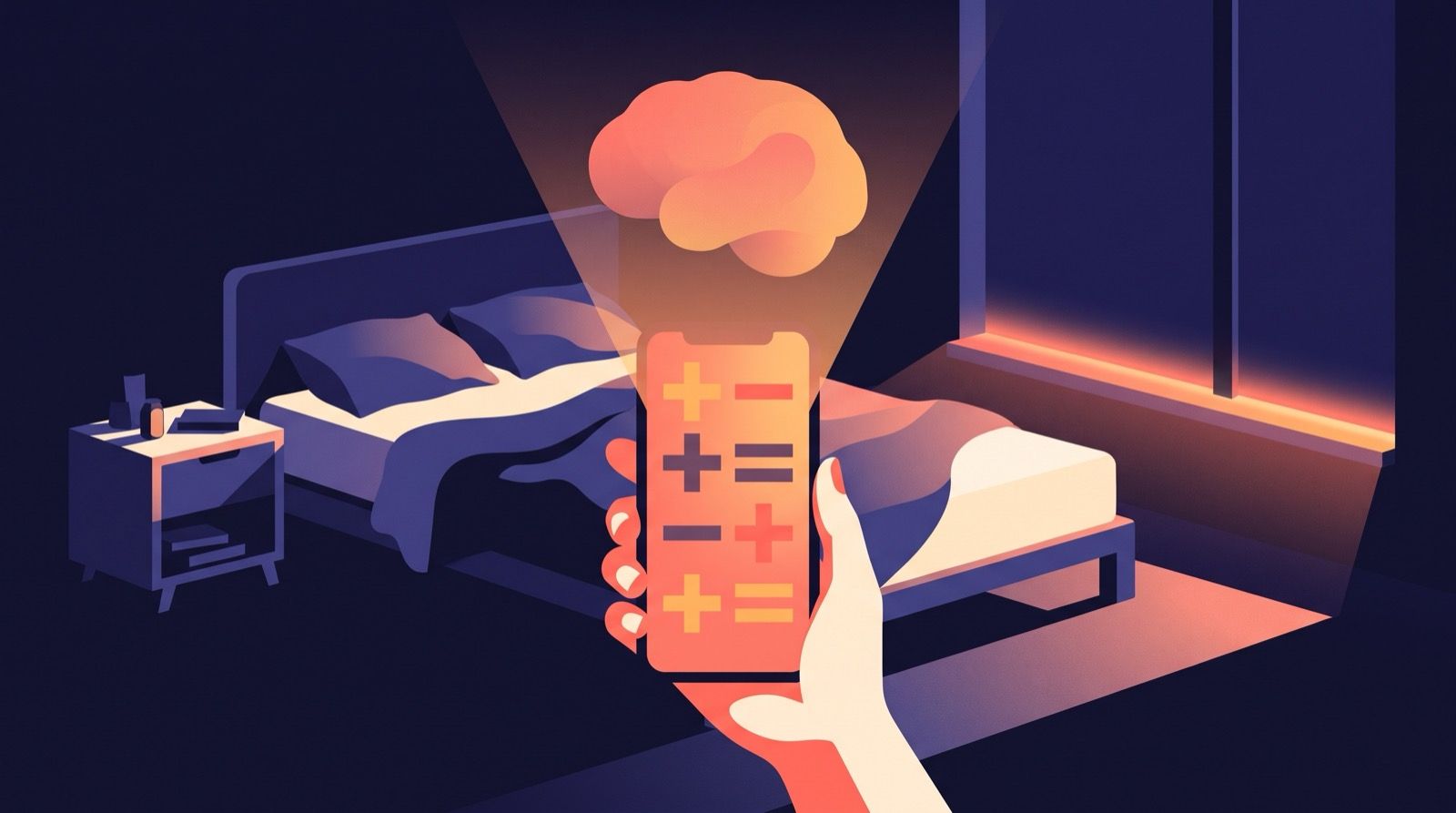
The alarm went off at 6:00. You know that because your phone says so. At 6:27 you were standing in the kitchen holding a cold kettle, with no memory of the three snoozes in between, and a creeping suspicion that you had agreed to something in a group chat.
Nothing was wrong with your character. Your alarm worked. Your hearing worked. What did not work, for several minutes, was the part of your brain that makes decisions. It was still coming online, and while it was offline it made one decision anyway: press the big soft button.
That gap has a name, a measurable duration, and a fairly well described neurobiology. It is also the reason a math alarm clock is a less silly idea than it first sounds.
Waking up is not a switch
Sleep inertia is the transitional state of lowered arousal right after waking, and it produces a temporary drop in performance. That is close to the definition given in Tassi and Muzet’s review in Sleep Medicine Reviews, which remains the standard reference. The same review notes that in the absence of serious sleep deprivation, the worst of it rarely runs past about half an hour, though it can be reported anywhere from a minute to a few hours.
The reason it takes time is regional. In Balkin and colleagues’ PET study in Brain, cerebral blood flow returned fastest to centrencephalic structures such as the brainstem and thalamus, which is roughly the machinery of being conscious at all. Over the following minutes, further increases showed up mainly in anterior cortical regions. Consciousness came back quickly. Alertness came back on a slower clock, and the authors linked the fading of sleep inertia to the reactivation of those front-of-brain areas.
Hilditch and McHill’s 2019 review in Nature and Science of Sleep puts the consequence plainly: prefrontal regions, the ones handling executive function, take longer to return to baseline than the rest. The last system back is the one you use for planning, restraint, and evaluating whether a decision is a good idea.
Which is a slightly unnerving thing to learn, because the first decision of your day is made in exactly that window, by exactly that system, while it is still warming up. Snoozing is not a moral failure. It is what a half-booted prefrontal cortex does when presented with a button.
Arithmetic is the sharpest measurement we have
Here is the finding that reframes everything. In Wertz and colleagues’ 2006 report in JAMA, performance on a short addition test taken immediately after waking was more impaired than performance after a full night without sleep. Not equal to a sleepless night. Worse than one, in those first minutes.
That result is not an accident of task choice. Addition is the workhorse of this literature precisely because it loads the systems that come back last. The meta-analysis by Arsalidou and Taylor, Is 2 + 2 = 4? Meta-analyses of brain areas needed for numbers and calculations (NeuroImage, 2011), found that calculation tasks recruit prefrontal areas alongside parietal ones. Holding a carry digit in mind while operating on it is working memory, and working memory is a front-of-brain job.
Recovery is slow and asymptotic rather than sudden. Jewett and colleagues, in the Journal of Sleep Research, tracked the dissipation curve and found it took roughly two to four hours to approach its asymptote, with subjective alertness recovering faster than cognitive performance. Hilditch and McHill cite work in which addition performance took up to three and a half hours to fully settle.
Now the honest complication, because this is where a lot of alarm app marketing quietly stops reading. Santhi and colleagues, writing in PLOS ONE in 2013, tested four domains after morning waking and found that alertness and sustained attention were hit harder than working memory and cognitive throughput, with speed suffering more than accuracy. So arithmetic is not uniquely wrecked by waking. It is one of several impaired capacities, and on some measures it holds up better than plain vigilance does.
The useful reading is not “math is the magic key”. It is this: solving something is a task you can fail at, visibly, in a way that pressing a button is not. That is what makes it worth putting between you and the off switch.
The snooze evidence is more interesting than the sermon
Snoozing is close to universal. Robbins and colleagues, in Scientific Reports in 2025, looked at more than 21,000 people across roughly three million nights of app data and found the snooze button used at the end of about 56 percent of sleep sessions. Around 45 percent of users snoozed on more than four mornings in five, and heavy users spent an average of about 20 minutes bouncing between alarms.
You would expect the research to condemn it. Mostly it does not. Mattingly and colleagues, in Sleep in 2022, found that snoozers did not sleep less overall or report more daytime fatigue than single-alarm risers, though they showed lighter sleep in the hour before waking and higher resting heart rates. Sundelin, Landry and Axelsson, in the Journal of Sleep Research in 2024, tested habitual snoozers directly and found that 30 minutes of snoozing either improved or did not affect cognitive performance shortly after rising, compared with waking at the first alarm. Their cognitive sample was small, and everyone in it was already a habitual snoozer, so the result travels less far than headlines suggested.
So the case against snoozing is not that those ten minutes poison you. It is narrower and, I think, more damning. Snoozing does nothing to move the recovery curve. It rents you a fragmented quarter hour of light sleep and hands the same impaired prefrontal cortex the same decision again, three or four times, until the decision it makes is the one you regret. The problem is not the sleep. It is the repetition of an unguarded choice.
And it is worth saying clearly what nobody has demonstrated. Hilditch and McHill concluded that there is currently no clear empirical evidence fully supporting any reactive countermeasure for immediate, objective improvement after waking, with the partial exception of caffeine taken before a short sleep. One experiment that compared performance after sleep, after quiet rest and after active waking found addition speed depressed in the first test session after sleep relative to the active-wake control, then recovering across subsequent sessions. Being awake and doing things is associated with better numbers than lying there. That is not the same as a trial proving that a puzzle at 6 AM shortens sleep inertia, and I am not going to pretend otherwise.
Six things that actually help
- Stop scheduling anything sharp inside the first half hour. Given the Jewett curve, the highest-value change is not a better alarm, it is moving the 6:15 reply to a work message to 7:00. Treat the first 30 minutes as unreliable and plan around it.
- Do not let the wake-up decision be the first decision. Decide the night before, when your executive systems are actually online, and make reversing that decision require getting up. Where the phone spends the night matters more than most people expect, which we covered in Your Phone Sleeps in Your Bedroom. Should It?
- If you snooze, snooze on a policy, not on impulse. A bounded, decided-in-advance snooze is a different thing from an open-ended one. The evidence says a short snooze is unlikely to hurt you. Nothing says an unbounded one helps.
- Get light and movement early, and expect modest returns. Santhi’s group found blue-enhanced morning light did essentially nothing for alertness or most performance measures in the inertia window. Morning light is still worth having for circadian timing. It is just not a switch either.
- Time caffeine honestly. Caffeine has the best evidence base of the countermeasures reviewed, but it is not instant, and its strongest support is for dosing before a short sleep rather than after a full night.
- Keep a second, independent alarm for anything that truly matters. Flights, exams, surgery rotations. No app on a phone can guarantee it will wake you, and anyone who tells you otherwise is selling something. If you are chronically dismissing alarms with no memory of it, that pattern has its own causes, and it is worth reading up before you buy anything.
For the underlying grogginess itself, we go deeper in Sleep Inertia: Why You Wake Up Groggy.
Where WakeSharp fits, and where it does not
WakeSharp’s free arithmetic mission is called Mind Games. To dismiss the alarm, you solve a few problems. That is the whole idea, and the reasoning is the one above: a task you can fail at cannot be completed by a hand that is still asleep. Pressing a button can. That is the entire mechanism, and it is a mechanism about the interface, not about neurochemistry.
Two things follow, and I would rather state them than let them be inferred.
The honest limit first. No published trial has tested WakeSharp’s missions against a plain alarm, and the broader literature has not established that any reactive task shortens sleep inertia. What a solvable puzzle reliably does is stop an unconscious dismissal. What it does not do is make the next twenty minutes trustworthy. Plan the morning as though you are impaired, because for a while you are.
Second, the design details that matter here. Snoozing is a policy you set, not a rule we impose: Off, Standard (two five-minute snoozes, five Sharpness points off each), or Tighten, which shortens the gaps to ten minutes, then five, then two. Those three are free. Strict Mode books four re-rings in advance, at 45 seconds and then 4, 8 and 12 minutes, where supported. The system Stop button on your phone always works, on both platforms, and we are not going to design around pretending otherwise. Mind Games also runs as one of the warm-up games afterwards, which is where the Sharpness Score comes from: it compares this morning’s performance against your own baseline, not against some ideal stranger.
Your alarm rings free, forever, and Plus is ad-free. Mind Games and Photo Proof are the free missions; the Plus missions gate when you create an alarm, never when one rings.
FAQ
Do math alarm clocks actually work?
They work at the thing they are designed for, which is preventing a dismissal you will not remember making. There is no controlled evidence that solving arithmetic speeds the dissipation of sleep inertia itself. Treat a math alarm clock as a lock on the off switch, not as a stimulant.
Is hitting snooze bad for you?
Less bad than the internet suggests. Mattingly’s 2022 cohort found no overall sleep loss or extra daytime fatigue among snoozers, and Sundelin’s 2024 experiment found 30 minutes of snoozing did not impair cognition in habitual snoozers. The catch is that snoozing does not accelerate recovery either, and it repeatedly hands an important decision to the least-recovered part of your brain.
How long does sleep inertia last in the morning?
The steepest recovery happens in the first 15 to 30 minutes, but Jewett’s data show performance approaching its asymptote only after roughly two to four hours, and some measures of addition performance take longer still. Subjective alertness recovers faster than actual performance, which is exactly why people overestimate how functional they are at 6:10.
What kind of math should an alarm ask for?
Something that needs a carry or a borrow, not single-digit recall you can answer from memory. The point is to load working memory briefly, which is what the arithmetic neuroimaging literature says calculation does. Difficulty that makes you angry at 6 AM is counterproductive; difficulty that makes you pause for two seconds is the target.
- sleep-inertia
- cognition
- morning-routine