
Sleep Science
Your Phone Sleeps in Your Bedroom. Should It?
2 September 2026 · 11 min read
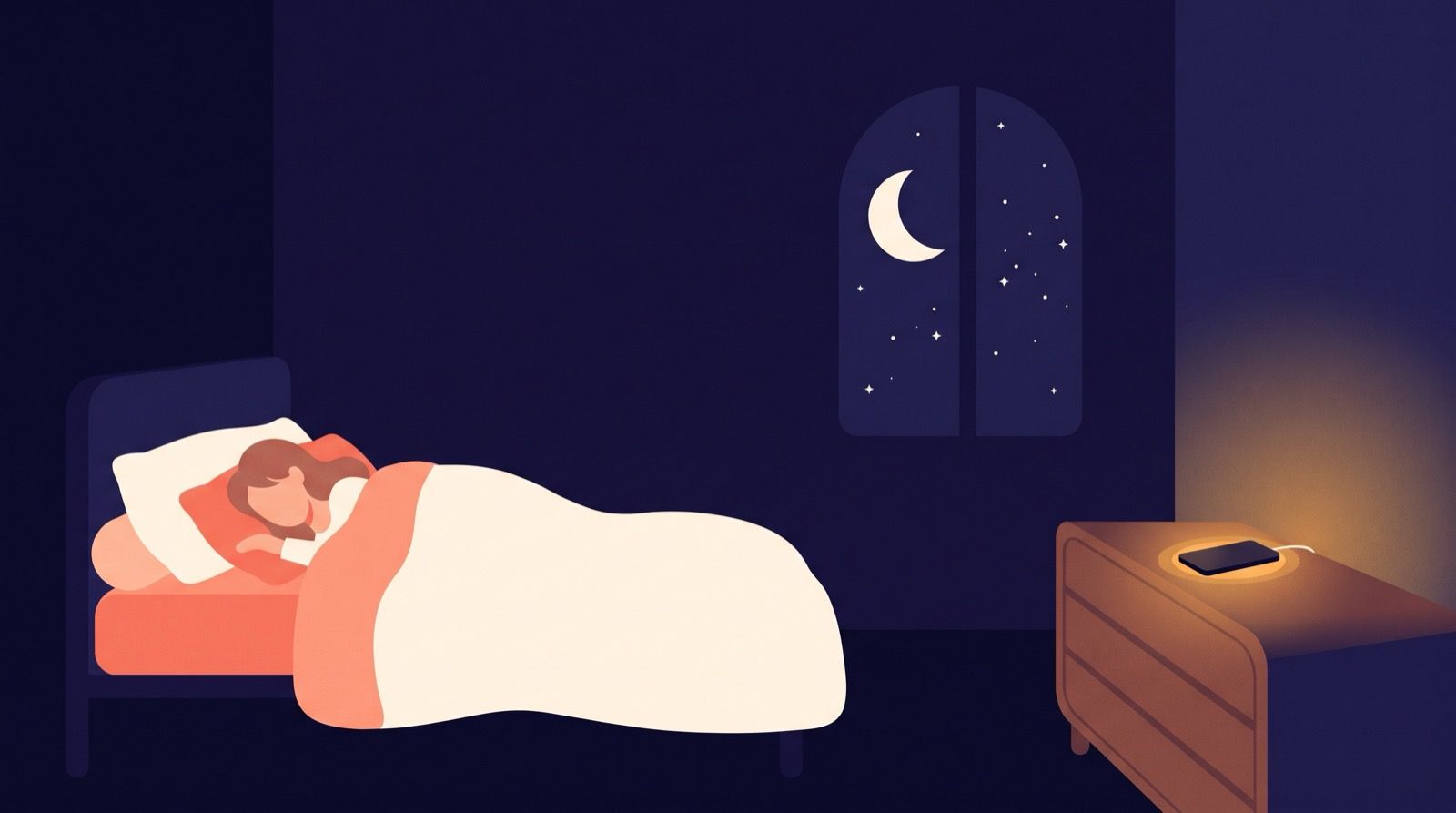
It is 11:40 PM. You pick up the phone to set tomorrow’s alarm. That takes four seconds. Then there is a message in a group chat, and the group chat has a link, and the link has a comment section, and the comment section has a person who is wrong.
It is now 12:50 AM. The alarm is still set. That part of the evening worked perfectly.
The standard advice at this point is to ban the phone from the bedroom. It is clean advice, it is easy to say, and for most people it is unusable, because the phone is the alarm clock. Telling someone to remove their alarm clock from the room where they sleep is not sleep hygiene. It is a scheduling error.
So let us ask a better question. Not “should the phone be in the room,” but “what job does the phone have while it is in the room, and does it know that?”
What the light research actually found
The blue-light story is real, and it is also routinely oversold. It is worth knowing both halves.
The study everyone half-remembers is Chang, Aeschbach, Duffy and Czeisler (2015) in PNAS. Twelve healthy adults spent fourteen days in a sleep lab. On five consecutive evenings they read a light-emitting eReader for about four hours before bed in otherwise very dim room light, and on five other evenings they read a printed book under the same conditions. Reading on the screen suppressed evening melatonin by roughly 55 percent, pushed the timing of the circadian clock about 1.5 hours later, added nearly ten minutes to how long it took to fall asleep, reduced REM sleep, and left people less alert the next morning.
Now read the protocol again. Four hours. Twelve people. A dim laboratory. That is a deliberately large dose, designed to make an effect visible. Twenty minutes of phone at arm’s length in a normally lit bedroom is a much smaller one.
There is a second wrinkle. Phillips and colleagues (2019), also in PNAS, found that at the group level, half of melatonin production was suppressed at under 30 lux, which is dimmer than ordinary indoor lighting. But they also found more than a fifty-fold difference in light sensitivity between individuals. One participant responded to 10 lux about as strongly as another did to 400 lux. So the honest answer to “does my screen wreck my melatonin” is that it depends enormously on who you are, and neither you nor anyone else currently knows which end of that range you sit on.
And the popular fix is weaker than advertised. When Nagare, Plitnick and Figueiro tested Apple’s Night Shift mode on an iPad, melatonin suppression did not differ significantly between the warm settings and no filtering at all. Changing the colour of a screen without changing its brightness or how long you stare at it does not buy you much. Turn the brightness down instead. That one is free and it works on physics.
The bigger problem is time, not wavelength
Here is where the field has quietly moved. In a 2024 theoretical review in Sleep Medicine Reviews, Bauducco and colleagues re-examined the proposed mechanisms linking technology to poor sleep: bright light, arousal, night-time disruption, and displacement. Displacement, meaning the phone simply eats the hours you meant to spend asleep, came out looking like the heavyweight.
A large Norwegian student study by Hjetland and colleagues (2025) in Frontiers in Psychiatry makes the same point from the other direction. Each additional hour of screen time in bed was associated with 59 percent higher odds of insomnia and about 24 fewer minutes of sleep. Crucially, the association did not differ between social media and other screen activities. If arousing content were the main driver, doomscrolling should have looked worse than a documentary. It did not. The clock was the culprit.
Which is a fancy way of restating something you already suspected: you did not lose an hour to photons. You lost it to interesting things. We have written about that pattern at length in revenge bedtime procrastination, and it explains more variance in most people’s sleep than any lightbulb ever will.
Then there is the 3 AM version
Displacement happens before you sleep. Fragmentation happens during.
Rod and colleagues (2018) in PLOS ONE tracked 815 young adults using high-resolution phone logs rather than self-report. Over four weeks, 41 percent had smartphone-interrupted sleep on at least one weekday. The frequently interrupted group reported about 48 minutes less sleep per night than the uninterrupted group, 7.0 hours against 7.8.
Presence alone shows up too. A meta-analysis by Carter and colleagues (2016) in JAMA Pediatrics, covering 20 studies and 125,198 children, found that having a portable screen in the sleep environment was associated with inadequate sleep even when the device was not actively used near bedtime. Falbe and colleagues (2015) in Pediatrics put numbers on it: children sleeping near a small screen got about 20.6 fewer minutes of sleep, with bedtimes roughly 37 minutes later. Those are children, and children are not small adults. But in adults, Exelmans and Van den Bulck (2016) in Social Science and Medicine found that 60 percent took their phone to the bedroom, and that calling or texting after lights out predicted longer sleep latency, worse sleep efficiency, more sleep disturbance and more daytime dysfunction.
The phone in the room is not radiating harm. It is offering an option, all night, at a moment when your judgement is at its worst.
A note on the “brain drain” claim
You may have read that a phone on the nightstand costs you cognitive capacity just by existing. That comes from Ward, Duke, Gneezy and Bos (2017), who found reduced available working memory when a participant’s own phone was merely present, face down and switched off.
It is a good study and it has not aged into certainty. A meta-analysis by Böttger, Poschik and Zierer (2023) in Behavioral Sciences, covering 22 studies and 43 effect sizes, found a small overall negative effect (g = -0.14), significant for memory but not for attention, and inconsistent across regions. So: real, small, and patchy. Do not move your charger because a phone emits an invisible attention field. Move it because your arm can reach it at 3 AM, and your arm has no judgement.
Seven things you can change before you sleep tonight
1. Give the phone one job, and say it out loud. Tonight the phone is an alarm clock. That is the whole contract. This sounds like a self-help affirmation and is really just a decision made in advance, while you still have the capacity to make one.
2. Move the charger out of arm’s reach, not out of the room. Across the room, on a dresser or a desk, is the sweet spot: still audible, still yours, but requiring you to stand up. Standing up is the entire mechanism. There is no research-backed magic distance, so use the arm test.
3. Do the notification cull. It takes ten minutes. Sort every app into three buckets: wake me at night (should be a very short list, typically calls from a handful of people), tell me in the morning, and never. Almost everything belongs in the third bucket. This is the single highest-yield thing in this article and it is free.
4. Silence the room, not the alarm. Do Not Disturb, bedtime schedules and their equivalents will quiet the notifications while leaving the alarm intact, but the details differ by platform and by setting, and getting them wrong is how people end up with a silent morning. We walked through exactly what stays audible in will your alarm ring on silent. Check yours before you rely on it.
5. Set an alarm for the start of the wind-down, not just the end of the night. A 10:45 PM chime that means “begin landing” does more than a 7:00 AM alarm can undo. Displacement is a time problem, so fight it with a time signal.
6. Turn the brightness down and lower your expectations of warm modes. Dim beats tinted. Distance from the screen also helps more than people think, since illuminance falls off sharply as you move a screen away from your eyes.
7. If you wake at 3 AM, do not reach. The American Academy of Sleep Medicine’s clinical practice guideline on behavioural treatments for chronic insomnia recommends stimulus control as a standalone therapy: the bed is for sleep, and if you are awake and frustrated, you get up rather than lying there teaching your brain that bed is where you scroll. The same guideline declines to recommend sleep hygiene on its own, which is a useful piece of humility for any article that hands you a list of rules.
Where WakeSharp fits, and where it does not
WakeSharp exists because of exactly this tension. The phone has to stay in the bedroom, because it is the alarm, but nothing about a phone naturally behaves like an alarm clock.
The relevant part is the mission. WakeSharp alarms are dismissed by completing a task that requires actual cognition: Mind Games (arithmetic) and Photo Proof (photograph the day’s prompt) are free, with Memory Match, Sequence Recall, Scan an Object, Walk It Off and Surprise Me in the Plus set. That Plus gate applies when you create an alarm, never when one is ringing.
What that changes about tonight is small but specific. Once dismissing the alarm involves standing up anyway, putting the charger across the room stops being a sacrifice and becomes the setup. Walk It Off is the most literal version of this, but any mission has the same effect: the phone you must walk to is also the phone you did not scroll at 12:50 AM.
The honest limits. WakeSharp does no sleep tracking of any kind, so it will not tell you what your night looked like, and it processes what it does need on-device. The system Stop button always works, on both iOS and Android, which means no alarm app can promise you will wake up; a mission raises the effort of a half-asleep dismissal, it does not remove the exit. If you are dismissing alarms without remembering it, that is worth reading about separately in why you sleep through alarms you don’t remember dismissing. And none of this fixes grogginess by itself, which is a sleep inertia problem with its own rules. Your alarm rings free, forever, and Plus is ad-free.
FAQ
Should I keep my phone out of my bedroom? Only if you have a separate alarm clock you actually trust. For most people the phone is the alarm, and removing it creates a bigger reliability problem than it solves. The evidence points at two specific harms, late-night time displacement and overnight interruptions, and both can be addressed by changing the phone’s job rather than its address: cull the notifications, put the charger out of arm’s reach, and decide the phone is an alarm clock tonight.
How far away should I charge my phone at night? There is no studied optimal distance, so ignore anyone who quotes one. Use a behavioural test instead: far enough that you have to get out of bed to reach it, close enough that you can hear the alarm clearly. A dresser or desk across the room usually satisfies both. The point is the standing up, not the metres.
Does airplane mode help you sleep? Indirectly, and mostly for one reason: it stops overnight notifications, which is where the measurable fragmentation comes from. It is not doing anything to your body via radio waves. Be careful with it, though, since airplane mode can interfere with time syncing and with calls you might genuinely need to receive. Do Not Disturb with a short allow-list is usually the better tool.
Does night mode or a blue light filter actually work? Less than the marketing implies. When Apple’s Night Shift was tested on an iPad, warm settings did not significantly reduce melatonin suppression compared with no filtering, because brightness and duration were unchanged. Lowering screen brightness and spending less time on the screen before bed are the levers that do real work. Treat colour tinting as a mild comfort feature, not a countermeasure.
- screen-time
- wind-down
- notifications
- bedroom