
Sleep Science
Hot Nights, Sharp Mornings: Sleeping Through Late-Summer Heat
1 September 2026 · 12 min read
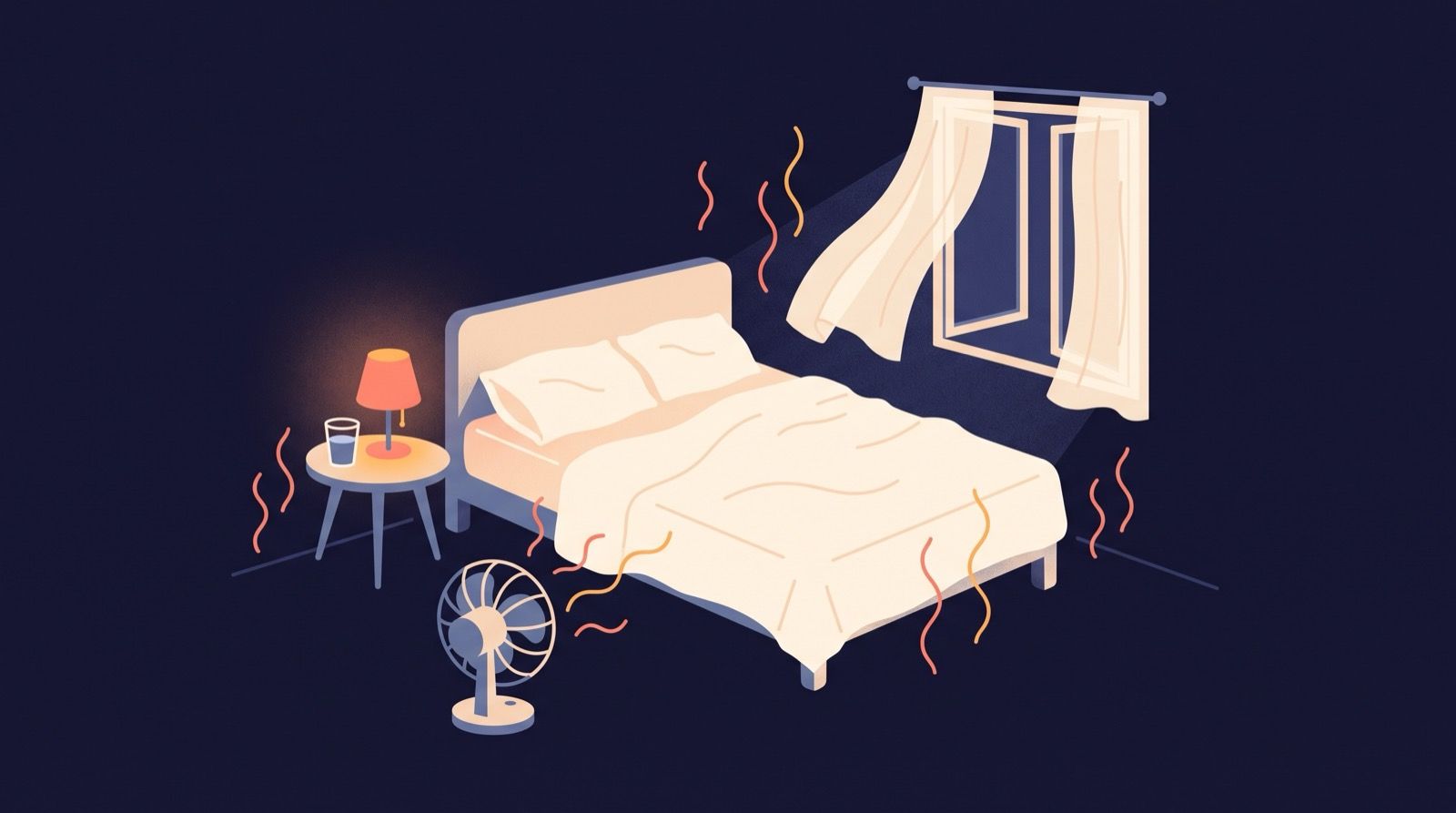
It is 3:40 in the morning on the first of September. The sheet is on the floor. You have flipped the pillow twice, tried the cool corner of the mattress, and are now lying very still on the theory that stillness generates less heat, which is true and not remotely enough. Outside it is 24 degrees and the air has not moved since Thursday.
At 6:30 the alarm goes off and you are a worse person than you were on Friday. Slower, shorter-tempered, unable to hold a sentence in your head long enough to finish it.
The instinct is to call this a discipline problem. But on a hot night, what failed was not your willpower. It was a piece of thermoregulatory plumbing that has to work before sleep can start at all, and heat is very good at jamming it.
Sleep starts with a temperature drop, not a decision
Your core body temperature runs on a daily rhythm, peaking in the early evening and falling through the night to a low point a couple of hours before your usual wake time. Sleep does not merely coincide with that fall. The fall is part of the trigger.
The mechanism is heat disposal through your skin. In the hour or two before sleep, the blood vessels in your hands and feet dilate, dumping warmth out of the body’s core and into the room. Kurt Kraeuchi and colleagues measured this directly and found that the size of that distal warming, the gap between how warm your extremities are and how warm your trunk is, was the best physiological predictor of how quickly people fell asleep, better than melatonin and better than core temperature itself (Kraeuchi et al., Nature, 1999).
Now picture that in a bedroom sitting at 28 degrees. Dumping heat requires somewhere cooler to dump it, and when the room is near your skin temperature, the radiator stops radiating. The core drop comes shallow and late, and sleep onset drags out behind it.
It does not stop at falling asleep. A review of the thermal environment and sleep by Okamoto-Mizuno and Mizuno describes the standard signature of a hot night: more wakefulness, less slow-wave sleep, less REM (Okamoto-Mizuno and Mizuno, Journal of Physiological Anthropology, 2012). Those are the two stages you least want to lose. Slow-wave sleep is the deep, restorative front half of the night. REM clusters in the back half and is unusually vulnerable, because during REM the body’s thermoregulatory reflexes are substantially suppressed: you largely stop sweating and shivering to defend your temperature. In a hot room, the practical way out of that bind is to cut REM short, or to wake you up.
Humidity makes the whole thing worse in a way that thermometers hide. In a laboratory study, sleepers at 35 degrees with 75 percent humidity lost significantly more stage 3 and REM sleep than at the same temperature with 50 percent humidity, and their body temperature stayed higher all night (Okamoto-Mizuno et al., Sleep, 1999). Sweat that cannot evaporate is not cooling you. It is just wet.
And it is not only you. Using more than 10 billion minute-level sleep measurements from wearables in 68 countries, Kelton Minor and colleagues found that warmer night-time temperatures reliably shorten sleep, mostly by delaying its onset, with the effect falling hardest on older adults, on people in lower-income countries and on women (Minor et al., One Earth, 2022).
So: not a character flaw. A physics problem, in a bedroom.
Six things to do tonight
Nothing here requires buying an air conditioner at 11pm. They are ordered roughly by return per unit of effort.
1. Cool the room hours before you need it cool
A bedroom that is hot at midnight was heated at 2pm. Sun through glass is the biggest input, so close blinds, curtains or external shades on the sun-facing side during the day and keep windows shut while outside is hotter than inside. Then reverse it: once the outdoor air drops below the indoor air, usually well after sunset, open up and flush the heat out. The EPA’s indoor guidance makes both points, on shading and on timing ventilation to the outside temperature (US EPA, Extreme Heat and Indoor Air Quality).
Also unplug the space heaters you did not know you owned. An idle games console, a laptop charging on the duvet and an old incandescent lamp are all small radiators.
2. Take a warm shower 1 to 2 hours before bed
This sounds backwards, and it is the best-evidenced item on the list. A systematic review and meta-analysis by Haghayegh and colleagues pooled the research on pre-bed water-based body heating and found that a warm shower, bath or even a foot bath, as short as 10 minutes and timed roughly one to two hours before bed, shortened the time it took to fall asleep (Haghayegh et al., Sleep Medicine Reviews, 2019).
The reason is the mechanism above. Warming the skin opens the blood vessels in your hands and feet, so when you step out, that dilated skin dumps heat faster than it otherwise would. You are not trying to feel cool in the shower. You are trying to have an efficient radiator running at bedtime. A cold shower feels wonderful for four minutes and does the opposite, clamping down the vessels that were supposed to do the work.
3. Leave your hands, feet and face out
Since heat leaves mostly through the extremities, hands and feet are the parts of you that should not be under anything. Feet outside the sheet, arms out, no socks. A cool damp cloth on the wrists, ankles or back of the neck cools blood close to the surface without soaking the bed. Give your face the same courtesy: a head buried in a pillow builds a humid little microclimate at exactly the temperature you were escaping.
4. Treat humidity as a separate problem
If the room is 27 degrees and clammy, a fan just moves the misery around. An air conditioner’s dry mode often costs less power than full cooling and does more for sleep. A dehumidifier works best run in the evening and switched off at bedtime, so you are not sleeping beside a warm compressor. Failing both: no drying laundry in the bedroom, extractor fan on after the evening shower, door open so moisture disperses.
5. Move air, and know where a fan stops working
A fan cools you by helping sweat evaporate, so it only works while the moving air is cooler than your skin. Above roughly the mid-90s Fahrenheit, around 35 degrees Celsius, both the EPA and CDC advise against relying on an electric fan for cooling, because at that point it is blowing hot air across you and can push your body temperature up rather than down (CDC, About Heat and Your Health).
Below that line, aim for a cross-breeze rather than a fan pointed at your face. One fan drawing cool night air in at one window and a second pushing hot air out at another beats either fan alone. If the noise is what keeps you awake, put the fan outside the room and leave the door open.
6. Change what you sleep on, not just what you sleep in
Memory foam and foam toppers are heat traps: they insulate exactly where your body is trying to shed warmth. Take the topper off for a week. Swap a heavy duvet for a single cotton or linen sheet, since both move moisture off the skin far better than polyester. Lightweight cotton nightwear beats sleeping with nothing on for the same reason: it wicks sweat away rather than leaving it pooled against you. And heat rises, so a mattress on the floor of a hot upstairs room is a reasonable September decision.
The part where heat is not just a comfort issue
Heat is a health risk before it is a sleep-quality inconvenience, and the risk is unevenly distributed: older adults, infants and small children, pregnant people, anyone with chronic heart, lung or kidney conditions, and anyone on medications that impair sweating or fluid balance, including some antidepressants, antipsychotics, diuretics and blood pressure drugs (CDC, About Heat and Your Health).
If that describes you or someone you check on, the list above is not the plan. The plan is air conditioning where it exists, a public cooling centre where it does not, hydration, someone checking in, and a word with a pharmacist or doctor about your medications. This article is about sleeping better in warm weather, not a substitute for medical advice.
What WakeSharp can actually tell you about a hot week
Start with the part most apps leave out. WakeSharp does not track your sleep. No stages, no hypnogram, no sleep score. Overnight temperature and stage estimates are a wearable’s job, and the studies above were largely done with them.
What WakeSharp measures is the other end: how sharp you are in the minutes after waking. Once you clear your alarm’s mission, a short warm-up game such as Mind Games or Reaction Tap produces a Sharpness Score, graded against your own rolling baseline rather than against strangers. That is a proxy for morning cognitive state, and a proxy is the right tool in a heat wave, because what you want to know is whether the heat is costing you anything that matters by daylight.
There is decent reason to think it will show. When researchers followed university students through a Boston heat wave, those in buildings without air conditioning were measurably slower on reaction-time tests and worse on working memory than students in cooled dorms (Cedeno Laurent et al., PLOS Medicine, 2018). Wrecked deep sleep and ambient heat push in the same direction, on the exact functions a morning warm-up measures.
So the practical use is simple: run the warm-up every morning across a hot week and the week after the weather breaks, then compare the shape of the line. A sag that recovers is a better reason to buy a dehumidifier than a vague feeling is. No sag is also useful information.
The honest limits. This cannot separate “I slept badly because of the heat” from “I am being cognitively taxed by the heat right now, at 6:30am, in a 28-degree bedroom.” Both are real, both are heat, and a one-minute game cannot tell them apart. A single morning tells you almost nothing; only the run of mornings means anything.
On the alarm itself: your alarm rings free, forever, and Plus is ad-free. The free missions are Mind Games, a short arithmetic sprint, and Photo Proof, which sends you to photograph the day’s prompt, on a hot morning a decent excuse to stand somewhere with moving air. Plus adds Memory Match, Sequence Recall, Scan an Object, Walk It Off and Surprise Me. The tier check happens when you create an alarm, never when one rings. And no app can promise you will wake up, ours included: the system Stop button always works, and it should. What an app can do is make leaving the bed take more than a swipe, which matters after a night your brain spent fighting the room instead of consolidating memories.
Early September is also when hot nights collide with restarting schedules, so if you are dragging a summer bedtime back to something school-shaped, the two jobs are one week’s work: see resetting a summer sleep schedule in one week.
FAQ
What is the best temperature for sleeping? Most sleep research lands around 16 to 20 degrees Celsius, roughly 60 to 68 Fahrenheit, under a normal amount of bedding. The number matters less than the principle: the room has to be cooler than your skin for your body to shed heat into it. Bedding, humidity and nightwear shift the ideal figure by several degrees, which is why two people in one bed can genuinely disagree.
How do you sleep in the heat without air conditioning? Stack the small effects, because none wins alone. Shade the windows by day and ventilate once outside air is cooler, warm shower one to two hours before bed, a single cotton or linen sheet with hands and feet uncovered, a cross-breeze rather than a fan aimed at your face, and humidity attacked separately from temperature.
Does a fan actually help you sleep when it is hot? Yes, up to a point. A fan speeds evaporation from your skin, which is real cooling, and its noise covers the street sounds that come with open windows. Above roughly 35 degrees Celsius it stops helping and can make things worse, because the air it moves is hotter than you are. Below that, aim it across the room rather than at your head.
Why do I keep waking up at 3am when it is hot? Two reasons that reinforce each other. The back half of the night is REM-heavy, and thermoregulation is largely switched off during REM, so a hot room hits hardest exactly then. Meanwhile the room has spent hours equilibrating with heat stored in walls and mattress, so it is often at its most oppressive long after you fell asleep. If the waking comes with a racing heart, breathlessness or confusion, that is a doctor question, not a bedding one.
- heat
- core-temperature
- summer-sleep