
Tips & Tricks
Sleeping With Earplugs: Is It Safe, and Will You Hear Your Alarm?
· 11 min read
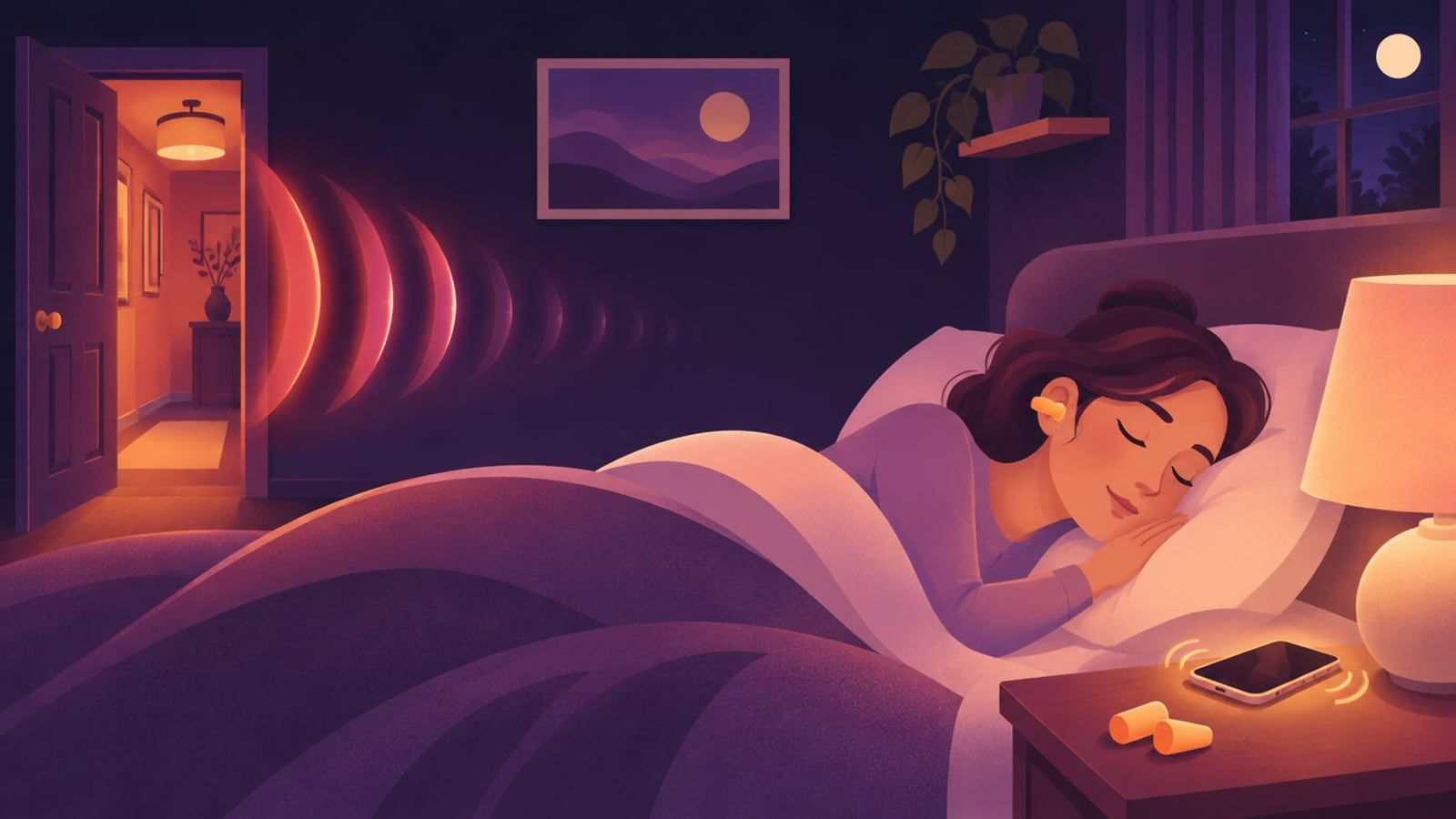
It is 11:40 on Thanksgiving night, and you are on the pull-out sofa in your sister’s den, which turns out to be where the furnace lives. Every twenty minutes it clanks awake. The dog patrols the hallway on hard nails. Through the wall, your brother-in-law snores like someone sanding a door. You want to be on the road by 7, so the alarm is set for 6:15.
In your bag is a pair of orange foam earplugs left over from a July flight. You know they will help you fall asleep. What keeps you up is whether they will also help you sleep straight through 6:15.
The short answer: sleeping with earplugs is safe for most people, even nightly, if the plugs are clean, the right size and not pushed deep; the realistic risks are earwax buildup and irritation or infection of the ear canal. Earplugs turn sound down, not off: sleep plugs are typically rated at 22 to 33 decibels of noise reduction, and NIOSH’s derating rule halves that label for foam plugs to estimate real-world protection. A loud alarm near your head can still get through, just less reliably, so test it with the plugs in the night before it matters.
Your ears never fully clock out
Whether it is a furnace, a hotel ice machine or a snoring partner, sleep does not switch hearing off. The brain keeps reacting to sound all night, and noises peaking as low as 33 decibels can trigger a faster heartbeat, a body movement or a brief awakening (Basner and colleagues, The Lancet, 2014). Those heart-rate jumps also fade with repeated noise far less than the brain’s own arousals do, so sleeping through a noise is not the same as being undisturbed by it.
Earplugs turn all of that down at the eardrum. In one study, 14 healthy volunteers slept in a sleep lab with recorded intensive care unit noise and light, which cut their REM sleep. With earplugs and eye masks, they got more REM sleep, reached it sooner, had fewer arousals and showed higher melatonin levels (Hu and colleagues, Critical Care, 2010).
The wider evidence is thinner than the earplug aisle suggests. A Cochrane review of intensive care patients linked earplugs, eye masks or both to about two extra hours of sleep, as patients rated it, and to less delirium, but most studies that measured sleep objectively found no benefit, and the evidence was rated low or very low quality (Hu and colleagues, Cochrane, 2015). For an ordinary bedroom, earplugs are plausible and cheap to test, not proven.
Is sleeping with earplugs safe?
For most people, yes: experts consider earplugs safe when used as directed, the Sleep Foundation says. Most of what goes wrong happens in the ear canal, a self-cleaning tube not built to hold foam for eight hours.
Earwax. The canal normally moves old wax outward, helped along by jaw movement. Block it with earplugs, earbuds or hearing aids for several hours a day and wax may build up instead, Mayo Clinic notes, bringing fullness, muffled hearing, ringing, itching or an earache (Mayo Clinic). Skip the cotton swab, which pushes wax deeper.
Infection. An outer-ear infection (swimmer’s ear) takes hold when moisture or broken skin lets bacteria in, and Mayo Clinic counts in-ear devices among the risk factors because they can make tiny breaks in the skin (Mayo Clinic). An earplug that has lived in a bag since July is not helping.
The sounds you wanted. Earplugs can also make you less likely to wake to an alarm or a crying child, the Sleep Foundation notes. If you are on duty for a small child, or the person most likely to hear a smoke alarm in an unfamiliar house, think twice or wear one plug. And if the snorer is your partner, earplugs may be treating the wrong person: Mayo Clinic advises seeing a clinician about loud snoring, especially snoring broken by periods of silence (Mayo Clinic).
Pain, discharge or lingering fullness deserves a clinician’s look. One red flag is urgent: if one ear wakes up suddenly muffled or quiet and stays that way with the plug out, do not assume it is wax. Sudden hearing loss is often first noticed on waking, often in one ear, and the NIH institute that studies hearing calls it a medical emergency (NIDCD).
What are the best earplugs for sleeping?
The one that seals comfortably enough to forget. The Sleep Foundation’s buying guide sorts them by material. Foam is the most common and usually the cheapest; you roll it thin, it expands in the canal, and it is meant to be replaced often. Moldable silicone generally rests at the entrance of the ear and barely enters the canal, an option if foam feels uncomfortable. Wax, which many people rate among the most effective, costs more and is single-use. Reusable soft silicone plugs often come with tips in several sizes and need cleaning between uses.
The number on the box is the Noise Reduction Rating, and it is a ceiling. It is measured in a lab with a technician fitting the plug; to estimate real-world protection, NIOSH’s derating scheme halves it for foam plugs and cuts it by 70 percent for other earplugs (Murphy and colleagues, Journal of the Acoustical Society of America, 2022). In the workplace fit tests that paper analyzed, fit mattered most: the same product gave people a wide range of protection, and one-on-one coaching added about 9 decibels over video instruction alone. Plugs also typically cut high pitches more than low ones. For sleep, a bigger number is not automatically better: you want the snoring blurred, not the alarm erased.
NIOSH’s fitting method for foam plugs takes three steps (CDC). With clean hands, roll the plug into a thin snake, pull the top of your ear up and back with the opposite hand, then slide the plug in and hold it while it expands. Your voice should sound muffled once it seals. Snug is the goal; the eardrum is not. The Sleep Foundation warns that pushing a plug too deep, or pulling it out too fast, can damage the canal, so take it out slowly in the morning.
Can you hear your alarm with earplugs in?
Earplugs make an alarm quieter, not silent, so the answer depends on how loud it is by the time it reaches your eardrum. That part you can work on tonight.
1. Test it in bed, plugs in
Set an alarm two minutes out, put the plugs in, lie down and turn off the light. If it barely registers while you are awake and listening, it is unlikely to reach you from deep sleep. Run the fan or noise machine during the test too: masking sound raises the bar your alarm has to clear, as our piece on white, pink and brown noise explains.
2. Bring the phone closer, not under the pillow
Earplugs reverse the usual advice to keep the phone across the room. Put it on the nightstand close to your head, speaker uncovered, and not under your pillow: Apple’s safety guidance says not to sleep on a device connected to power or put it under a pillow (Apple).
3. Raise the alarm’s own volume
On iOS 27, open Settings, then Sounds and Haptics, turn off Match Ringtone Volume under Alarms and Timers, and drag that slider up (Apple); on iOS 26, raise Ringtone and Alerts on the same screen. On Android, press a volume button, tap the menu and raise Alarm volume (Google). Silent mode does not mute an iPhone Clock alarm, while on Android, Do Not Disturb has to allow alarms, as our Silent and Do Not Disturb guide explains.
4. Pick a low, buzzy tone
In a sleep-lab study of 39 young adults, low-pitched square-wave beeps at 400 and 520 Hz woke people at significantly lower volumes than the other signals tested (Bruck and colleagues, Journal of Sleep Research, 2009). Earplugs typically cut highs more than lows. We know of no study that tests the two together, but they point the same way: through foam, a low, harsh buzz is a better bet than a bright chime.
5. Add something you can feel
Vibration goes straight past an earplug. On iPhone, an alarm’s Sound setting includes vibrations, though Apple notes alarm haptics are off in StandBy (Apple); Google’s Clock app on Android has a Vibrate option on each alarm (Google). A buzzing nightstand is easy to miss, though. A watch is harder to ignore: an Apple Watch alarm can tap your wrist, and Push Alerts from iPhone sends iPhone Clock alarms to the watch (Apple). Other watches and bands may have a vibrating alarm too.
6. Back up the morning that matters
For a flight or an early drive, set a second alarm on another device (one set on the watch itself counts) and run through our night-before alarm checklist. A full house also has the oldest backup there is: ask whoever gets up first to knock.
Earplugs and an eye mask
Guest rooms are rarely dark: a streetlight, a hallway nightlight, the glow of somebody’s router. In a study of 94 young adults, a week of sleeping in an eye mask, compared with a week without one blocking light, brought better learning of new word pairs and slightly faster reaction times, though people did not rate their sleep any better (Greco and colleagues, Sleep, 2023). Modest effects from a modest purchase.
Where WakeSharp fits
WakeSharp is an alarm app in which each alarm ends with a mission: a few sums, a memory game, real steps, a retaken photo of a spot you chose the night before. It cannot push sound through foam any better than your phone’s speaker can, and it does not measure sleep.
On iPhone, the sound picker has a Loud category of tones for alarms that have to stand out: preview a few with the plugs in, keep one you can still hear, then run the test from step 1. A Loud tone does not override your iPhone’s alarm volume, which iOS controls, so set that first. On Android, preview the tones the Google Play version offers. On iPhone, WakeSharp alarms ring through Silent mode and Focus once alarm permission is granted. On Android the alarm rings through silent mode, and through Do Not Disturb when Do Not Disturb allows alarms; Total Silence mutes every sound.
Once you hear it, the mission asks for deliberate attention rather than a reflex swipe at a muffled sound. However you quiet the alarm, the morning only counts once the mission is done. Your phone’s own controls always work: nothing stops you switching the phone off. No app can promise you will wake up, which is why step 6 stays on the list.
FAQ
Is it bad to sleep with earplugs every night?
Not for most people, if the plugs are clean, fit well and are not pushed deep. A canal blocked for hours every night is more prone to wax buildup, so take the plugs out when you get up, give your ears a night off when the room allows, and replace foam plugs often. If fullness, itching or muffled hearing lingers, stop and get your ears checked.
Can earplugs cause an ear infection?
They can contribute to one: Mayo Clinic lists in-ear devices among the risk factors for outer-ear infection. Insert plugs with clean hands, as NIOSH advises, and do not reuse disposable plugs for weeks. See a clinician for itching, redness, pain when you tug the outer ear or any discharge, and urgently for severe pain or fever.
Do earplugs cause earwax buildup?
They can, when the canal is blocked for several hours a day, Mayo Clinic notes, though most people never need to remove wax at all. If an ear feels full or muffled for several days, or you feel dizzy or notice hearing loss, see a clinician instead of reaching for a cotton swab.
Are there different sizes of earplugs?
Yes. Material, size and shape all affect comfort, the Sleep Foundation notes, and reusable plugs are often sold with several tip sizes, so finding your pair can take trial and error. A plug that aches, will not seal or works loose overnight is probably the wrong size or shape. A silicone plug that sits at the entrance of the ear is worth trying instead.
Back on the pull-out sofa
The whole routine takes about three minutes. Roll, pull, hold. Set an alarm two minutes out and listen for it with the lights off. If it gets through, put the phone on the nightstand, speaker clear and charger seated, and sleep. If it does not, turn it up, pick a lower and harsher tone, or strap on a watch if you brought one.
At 6:15, take the plugs out slowly, toss them if they are disposable, and check that both ears sound like your ears. The furnace will still be clanking.
- sleep-environment
- white-noise
- alarm-reliability