
Sleep Science
Sleep Paralysis: Why You Wake Up and Can't Move (and How to Make It Rarer)
· 11 min read
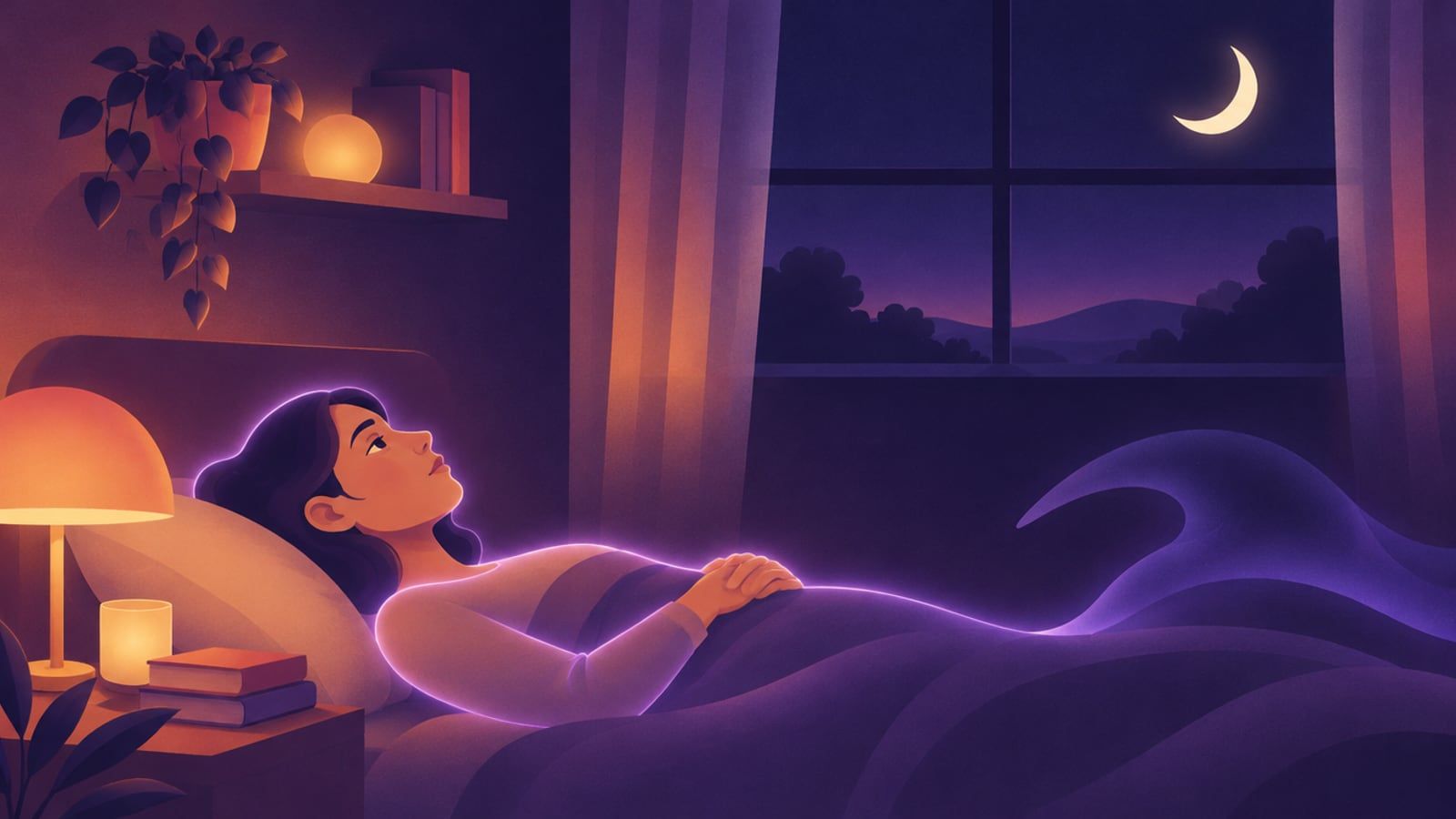
It is 5:52 on a Monday morning and you are awake. You can see the room: the grey edge of the curtain, the charging light on your phone, the jacket on the door that, for one long second, looks exactly like someone standing there. You try to sit up. Nothing happens. You try to lift a hand, then a finger, then to say anything at all, and your body ignores every request. Something heavy seems to be sitting on your chest.
Maybe half a minute later (it felt like ten minutes), a finger twitches, the weight lifts, and it is over. The jacket is a jacket. Your heart is going as if you just ran for a train.
Rewind the weekend: up past 1 AM on Saturday, asleep until almost 11 on Sunday, then lying awake on Sunday night because your body had no intention of being tired at 10:30. That detail explains more about this morning than anything in the doorway.
The short answer: sleep paralysis is a brief spell, usually seconds to a few minutes, when your mind wakes up while your muscles are still under REM sleep’s paralysis, often with a sense of someone in the room or a weight on your chest. About 7.6 percent of people have at least one episode in their lifetime, and about 28 percent of students. Medical sources call it harmless, and the standard advice for making episodes rarer targets the triggers you can change: short, broken or irregular sleep, and sleeping on your back.
What causes sleep paralysis?
Several times a night, your brain paralyses you on purpose. During REM sleep, the stage of the most vivid dreams, the body goes into atonia, a temporary paralysis of the muscles, with two exceptions: the eyes and the muscles that control breathing (Sleep Foundation). Without it, you would act out your dreams. Sleep paralysis is that switch still being on when you regain awareness: REM’s atonia carrying over into wakefulness, often with vivid waking dreams attached (Sharpless, Neuropsychiatric Disease and Treatment, 2016).
The cleanest evidence comes from a Japanese lab that caused it on purpose. Takeuchi and colleagues woke 16 volunteers during the night, kept them up for an hour, then let them sleep again. After 71.9 percent of these interruptions the sleepers dropped straight back into REM, and six interruptions produced sleep paralysis, all but one out of those sudden REM periods. The recordings showed brain waves typical of wakefulness alongside REM’s continuing muscle silence (Sleep, 1992). Awake upstairs, still asleep downstairs.
Timing matters too. REM periods lengthen through the night, from a few minutes at first to around an hour later on (Sleep Foundation), so the last stretch before your alarm is prime territory for waking mid-dream. (The cycles themselves are messier than the famous 90 minutes, as our piece on sleep cycles explains.)
Why it feels like someone is in the room
The hallucinations are what turned sleep paralysis into folklore. Cheyne and colleagues sorted them into three clusters (Consciousness and Cognition, 1999):
- The intruder: a sensed presence, fear, things heard or seen.
- The incubus: pressure on the chest, difficulty breathing, sometimes pain.
- Unusual bodily experiences: floating, flying, leaving your body, even bliss.
These accounts are remarkably consistent across time and cultures, the likely origin of many a “sleep paralysis demon”. The authors proposed that the intruder starts in a hypervigilant state in the midbrain, and attributed the chest pressure to the effect of REM’s muscle shutdown on how breathing feels. Breathing itself carries on: feelings of suffocation are common, the clinical review notes, but the breathing muscles are exactly the ones REM leaves alone.
Fear seems to feed the whole thing. Jalal’s panic-hallucination model proposes that escalating fear makes episodes longer and scarier and helps cause future ones (Frontiers in Psychology, 2016). It is a model, not a settled finding, but it is the reasoning behind the relaxation approach below.
Who gets sleep paralysis?
More people than you would guess. A systematic review pooling 35 studies and 36,533 people found that 7.6 percent of the general population had at least one episode in their lifetime, rising to 28.3 percent of students and 31.9 percent of psychiatric patients (Sharpless & Barber, Sleep Medicine Reviews, 2011). Weekly episodes are much rarer, reported by 0.8 percent of 8,085 adults surveyed in Germany and Italy (Ohayon et al., Neurology, 1999).
A 2018 review of 42 studies grouped the associated factors into themes including substance use, stress and trauma, genes, anxiety and sleep problems, and found sleep paralysis particularly common in post-traumatic stress disorder (PTSD) (Denis, French & Gregory, Sleep Medicine Reviews, 2018). A UK twin study estimated a moderate genetic influence of about 53 percent (Denis et al., Journal of Sleep Research, 2015). The direction of cause is often unknown, but the factors you can change cluster around sleep itself.
How to stop sleep paralysis: six ways to make it rarer
An honest framing first: the authors of a 2020 pilot study noted that no clinical trial of any sleep paralysis treatment had been published (Jalal et al., Frontiers in Neurology, 2020). So “stop” really means “make rarer”, and the steps below target the known triggers.
1. Keep one wake time, seven days a week
The NHS recommends a regular bedtime and wake time, and links sleep paralysis to the disrupted sleep of shift work and jet lag. A 2024 clinical review agrees, naming irregular sleep-wake schedules and sleep deprivation as predisposing factors (Stefani & Tang, Sleep Medicine Clinics, 2024). The usual saboteur is the weekend: long lie-ins push Sunday’s bedtime later, and Monday’s alarm cuts off the REM-heavy end of a short night. Add sleep at the front of the night instead; our piece on weekend lie-ins explains why.
2. Get enough sleep
Cleveland Clinic lists sleep deprivation among the links too, and the NHS suggests 7 to 9 hours. To check for a chronic shortfall, our sleep debt calculator compares seven nights with your target and shows how much your nights vary.
3. Sleep on your side
In surveys of 6,730 people, more reported episodes on their backs than in all other positions combined, and lying on the back was three to four times more common during an episode than when falling asleep normally (Cheyne, Journal of Sleep Research, 2002). A firm pillow behind your back is the low-tech way to stay there.
4. Stop drifting back into the morning
The lab recipe was a wake-up followed by a return to sleep that went straight into REM. A snooze habit repeats the wake-then-sleep-again part, in the most REM-heavy stretch of the night. Nobody has tested whether snoozing triggers episodes, and its measured costs are smaller than its reputation (what the snooze button really costs). But if your episodes cluster on snooze mornings, the experiment is cheap: set the alarm for when you actually get up, and get up.
5. Watch late alcohol, stress and new medications
Substance use and stress both appear in the 2018 review, and the NHS advises avoiding alcohol and caffeine shortly before bed. Cleveland Clinic also lists certain medications; if episodes began with a new prescription, raise it with the prescriber rather than stopping it yourself.
6. Take the mystery out of it
The most basic treatment the 2016 clinical review describes is reassurance and education, because shame and frightening explanations add to the distress. That matters practically: dreading sleep leads people to avoid it, and lost sleep is a trigger.
How do you get out of sleep paralysis?
Cleveland Clinic is blunt: there is no way to stop an episode as it happens. The two main ways to ride one out pull in opposite directions.
- Move something small. You may come out sooner by moving one finger, then two (Cleveland Clinic).
- Or stop fighting it. Jalal’s meditation-relaxation approach: remind yourself this is sleep paralysis, harmless and temporary; step back from the fear; turn your attention to a pleasant memory; let your muscles go slack. In a 2020 pilot, six people with narcolepsy used it for eight weeks and their days with an episode fell by half, unlike a deep-breathing group of four. Tiny, promising, unproven.
- Brief whoever shares your bed. Attempts to comfort someone during an episode often end it (Sharpless, 2016).
Afterward, sit up with a light on for a few minutes before lying down again, on your side: a sensible precaution given the lab findings, not a tested treatment. For calibration: of undergraduates with sleep paralysis who had tried to break an episode, only about half said it worked (Sharpless & Grom, Behavioral Sleep Medicine, 2016).
Is sleep paralysis dangerous? When to see a doctor
On its own, no. The NHS calls it scary but harmless, and the 2024 review describes episodes as benign, resolving on their own. In the undergraduate study, only about 15 percent reported clinically significant distress or interference.
See a doctor when:
- It comes with overwhelming daytime sleepiness or sudden weakness when you laugh. Sleep paralysis is a classic symptom of narcolepsy, alongside excessive daytime sleepiness, vivid hallucinations and cataplexy, a sudden loss of muscle tone triggered by strong emotion such as laughing, surprise or anger (MedlinePlus). Narcolepsy affects about 1 in 2,000 people in the US and needs a sleep specialist.
- Episodes are frequent and you dread bedtime, or you are tired all the time (NHS).
- You snore loudly or wake gasping. Obstructive sleep apnea is among the conditions associated with sleep paralysis (Sharpless, 2016).
- It began with a new medication, or alongside trauma symptoms, panic or anxiety.
On treatment, the 2024 review says no drug treatment is required: sleep habits come first, and cognitive behavioural therapy (CBT) can help when anxiety and frightening hallucinations come along. For persistent episodes, the NHS notes that a specialist may also suggest a medicine more often used for depression. And one safety line: sleep paralysis ends within minutes. Weakness, numbness or trouble speaking that persists once you are fully awake and up is something else, and needs urgent medical help.
Where WakeSharp fits (and where it can’t)
An alarm app can do nothing about REM atonia. What it can help with is the most boring lever in this article: the same wake time, every day.
In WakeSharp, an alarm can repeat every day rather than on weekdays only, so Saturday stops drifting two hours past Tuesday. Pair it with a walking mission such as Walk It Off, which asks you to take real steps, counted by your phone, and the alarm’s job becomes getting you upright rather than back into the REM-heavy doze. However you quiet the alarm, the morning only counts once the mission is done.
The limits matter more than usual here. WakeSharp does not track sleep, cannot tell which stage you are in, and cannot detect, prevent or end an episode. It is not a treatment or a substitute for a doctor. Your phone’s own controls always work: nothing stops you switching the phone off. And a fixed wake time only helps if bedtime moves with it.
FAQ
Can sleep paralysis kill you?
Medical sources say no. The NHS calls it harmless, and your breathing muscles are exempt from REM paralysis, so the weight on your chest is a sensation, not suffocation. The real costs are indirect: dread of bedtime, lost sleep and, occasionally, a missed diagnosis such as narcolepsy or sleep apnea.
Can lack of sleep cause sleep paralysis?
Short and broken sleep are among its most consistent associations, and disrupted sleep can trigger it in the lab: in Takeuchi’s study, interrupting sleep sent healthy volunteers straight back into REM and produced episodes. Genes, stress and anxiety play a part too, but episodes that cluster after short or irregular nights are a pattern worth acting on.
Is it normal to dream while half awake?
Yes. In a survey of 4,972 people in the UK, 37 percent reported hallucinations while falling asleep and 12.5 percent while waking up (Ohayon et al., British Journal of Psychiatry, 1996). When that imagery arrives with REM’s paralysis still in force, it is sleep paralysis. Mention such hallucinations to a doctor if they come with excessive daytime sleepiness, a combination that can point to narcolepsy.
How long does sleep paralysis last?
Usually seconds to a few minutes. The clinical review gives a typical range of seconds up to 20 minutes, averaging about six. Episodes end on their own, often sooner if someone touches you or speaks to you.
The jacket was always a jacket
If you woke this morning unable to move, here is what happened: your brain came back online a few seconds before your muscles did, and a dreaming mind filled the gap with the scariest explanation available. It is common, harmless on its own and likeliest after short, broken or shifting nights. Pick a wake time you can keep for the next seven days, sleep on your side, and if episodes keep coming with daytime sleepiness or dread, take them to a doctor.
- rem-sleep
- sleep-schedule
- sleep-regularity