
Sleep Science
What Time Should You Go to Bed? Work Backward From Sharp
6 September 2026 · 10 min read
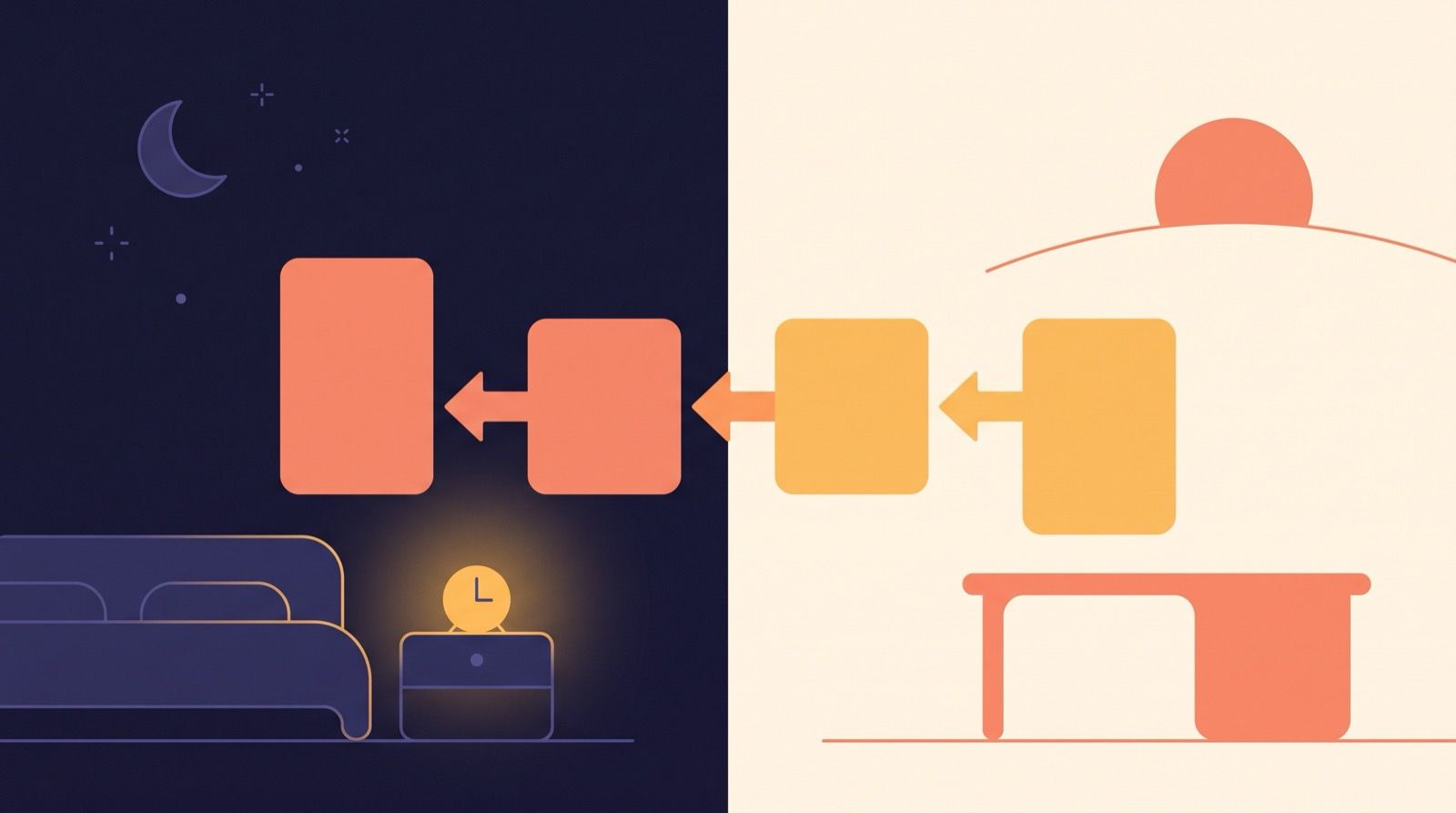
It is 11:20 on a Sunday night. Your alarm is set for 6:30. You run the arithmetic everyone runs: seven hours and ten minutes, close enough to the sacred eight, lights out. Monday at 9:00 there is a call where you have to think out loud in front of people who will remember what you said.
Monday at 9:00 you are present and not much else. You have answers, but they arrive a beat late. You reread the same line in the deck twice. By 10:15 your head finally turns over properly, which is roughly forty minutes after anybody needed it to.
The arithmetic was not wrong. It was aimed at the wrong target.
Your alarm is not your deadline
The alarm is an event in the middle of the process, not the end of it. Nothing important happens at 6:30. The important thing happens at 9:00, and the question that matters is not “how many hours of sleep can I get” but “what time do I have to start the night so that I am usable at the moment I am needed.”
Those are different questions with different answers, usually about an hour apart. Counting back from the alarm quietly assumes that the second the alarm rings you are the same person you were at 4:00 yesterday afternoon. You are not, and there is a well-studied reason for that.
The four things the naive count leaves out
1. The inertia window
Sleep inertia is the transitional state right after waking: lowered arousal, slowed reaction, worse decisions. Tassi and Muzet’s review in Sleep Medicine Reviews describes it as a temporary decrement in performance after awakening, with the sleep stage you were in beforehand as one of the strongest determinants: being pulled abruptly out of slow wave sleep produces more of it than waking from lighter stages.
A more recent review by Hilditch and McHill in Nature and Science of Sleep is blunt about the size of the effect: the impairment in the first fifteen to thirty minutes after waking can match or exceed what you would get from meaningful sleep loss, and full recovery is often not complete until roughly an hour in. It also gets worse if you are already short on sleep, and worse again at the wrong clock time. In a forced desynchrony study, Scheer and colleagues found sleep inertia around 3.6 times larger when people woke during the biological night than during the biological day.
So the honest budget is not zero. It is fifteen minutes on a good morning and closer to an hour on a bad one. We have written about what is actually happening in that window and it is not something you can decide your way out of.
2. The getting-ready block
This one is not science, it is honesty. Time the shower. Time the coffee. Time the part where someone else in the house needs socks. Most people underestimate this block by ten to fifteen minutes, every single day, and then borrow those minutes from the front of the night.
3. Time in bed is not time asleep
You do not fall asleep at lights out, and you do not stay asleep all night. The National Sleep Foundation’s expert panel, reporting in Sleep Health under Ohayon and colleagues, reviewed 277 studies and landed on sleep latency of fifteen minutes or less as an indicator of good quality across age groups, with sleep efficiency (the share of time in bed you spend actually asleep) of 85 percent or higher.
Eighty five percent sounds high until you turn it around. At 85 percent efficiency, eight hours in bed is six hours and fifty minutes asleep. The missing seventy minutes did not go anywhere dramatic. They went into settling, one trip to the bathroom, and a stretch at 4 a.m. where you were awake enough to notice the room.
4. Your actual sleep need
The joint consensus statement from the American Academy of Sleep Medicine and the Sleep Research Society recommends that adults sleep seven or more hours per night on a regular basis. Note the shape of that: a floor, not a target, and the same statement acknowledges that individual need varies with genetic, behavioral, medical and environmental factors. Seven is where the evidence stops arguing, not where you personally stop being tired.
Run the arithmetic backward
Pick the first thing tomorrow that actually requires cognition. Not the alarm. Not “getting up.” The meeting, the exam, the drive, the interview, the surgery, the toddler handoff that goes badly when you are slow.
Then subtract, in order:
| Step | Subtract | Clock |
|---|---|---|
| First commitment that needs your head | 9:00 am | |
| Inertia window, warm-up, light, coffee | 45 min | 8:15 am |
| Travel or commute | 30 min | 7:45 am |
| Getting ready, honestly timed | 45 min | 7:00 am (alarm) |
| Time in bed to get 7.5 hours asleep at 85 percent efficiency | 8 h 50 m | 10:10 pm (lights out) |
That is the whole method. Your bedtime tonight is 10:10, not 11:00.
Two notes on the last row, because this is where people double count. Sleep efficiency already absorbs your latency and your night wakings, so divide your sleep need by your efficiency (7.5 / 0.85 = 8.8 hours) or add latency and wake time separately. Do not do both. And if you have no idea what your efficiency is, 85 percent is a reasonable working assumption for a healthy sleeper; use a lower number if you know you are a slow starter.
Compare that to the naive version. Alarm at 7:00, minus eight, bedtime at 11:00. Same alarm, same morning, fifty minutes less sleep than you thought you were getting, and a 9:00 commitment that lands right at the edge of the inertia window instead of safely past it.
Where your numbers will differ from mine
Chronotype moves the whole window. Sleep timing in a population is roughly bell shaped, and as Roenneberg and colleagues put it in Sleep Medicine Reviews, the extreme early types are waking up around the time the extreme late types are falling asleep. If your body does not produce sleep pressure until midnight, a computed bedtime of 10:10 is a computed lie. The fix is not willpower; it is shifting the whole window over weeks, or accepting a later commitment where you can.
Sleep need is not eight for everyone. Seven or more is the anchor. Find your own by tracking how you feel on a stretch of unconstrained mornings, not by trusting the round number in a headline.
Do not try to land on a cycle boundary. The idea that you must wake at a multiple of ninety minutes is tidier than the biology. Cycle length varies within and between people, so a bedtime engineered to the minute around it buys less than getting the total right.
When the computed bedtime does not work
Here is the part most bedtime advice skips. A computed bedtime is a target, not a command. You cannot decide to fall asleep, and grinding away at it in the dark is actively counterproductive.
If you are lying there wide awake, the evidence-backed move is to get up. Stimulus control, one of the single-component therapies the AASM’s clinical practice guideline recommends for chronic insomnia, works by keeping the bed associated with sleep rather than with frustration: go to bed when sleepy, leave the bedroom when you cannot sleep, come back when you are drowsy again. Twenty minutes of staring is the usual rule of thumb. If this is happening most nights, that is a conversation for a clinician, not a blog post.
And if the problem is not that you cannot sleep but that you will not go, that is a different animal with its own rather uncomfortable name. The arithmetic does not fix it. It only tells you exactly what it is costing.
The wake side is already automated. The bed side is on you.
This is the one place WakeSharp fits into tonight’s problem. Smart calendar alarms read your calendar on device and ring a set number of minutes before your first commitment, rechecked overnight so a moved 8:00 meeting moves the alarm with it. That is the top half of the table above, done for you: you tell it how much runway you need in front of the commitment, and it does the subtraction every night without you re-deriving it at midnight.
The bottom half of the table is not something an app can do. WakeSharp does not track your sleep, so it does not know your real efficiency or your real latency; those numbers have to come from you. It cannot make you go to bed at 10:10. And no alarm app can guarantee you wake up, ours included. What it can do is stop the wake-side arithmetic from silently drifting when your calendar changes, which is the failure mode that costs most people their morning.
FAQ
What time should I go to bed if I have to wake up at 6 a.m.?
Work backward from your sleep need, not from six. For 7.5 hours asleep at 85 percent sleep efficiency you need about 8 hours 50 minutes in bed, which puts lights out near 9:10 p.m. If seven hours is enough for you, that is about 8 hours 15 minutes in bed and a 9:45 p.m. bedtime. Then check the other direction too: if your first real commitment is at 7:30, a 6:00 alarm may not leave enough room for the grogginess window.
Is 8 hours in bed the same as 8 hours of sleep?
No. The National Sleep Foundation panel treats sleep efficiency of 85 percent or higher as good quality, and at that rate eight hours in bed is closer to six hours and fifty minutes asleep. Time in bed is the budget; sleep is what you actually withdraw.
How long does it take to feel properly awake after the alarm?
Typically fifteen to sixty minutes. Reviews of sleep inertia put the sharpest impairment in the first fifteen to thirty minutes with full recovery often taking about an hour, and it lasts longer if you are sleep deprived, if you were woken out of deep sleep, or if you woke during your biological night. Budget for it rather than being surprised by it, and if you want the hour-by-hour version, we broke down the first thirty minutes separately.
What if I calculate a bedtime and then cannot fall asleep at it?
Do not lie there fighting it. Stimulus control, a component of cognitive behavioral therapy for insomnia recommended in AASM’s guideline, says to leave the bedroom when sleep is not coming and return when you are drowsy. If your computed bedtime is consistently an hour before your body produces any sleep pressure, the bedtime is wrong for your chronotype: shift it in fifteen-minute steps across a couple of weeks rather than demanding it all tonight.
- bedtime
- sleep-schedule