
Sleep Science
SAD Lamps: How to Use Light Therapy on Dark Winter Mornings
· 11 min read
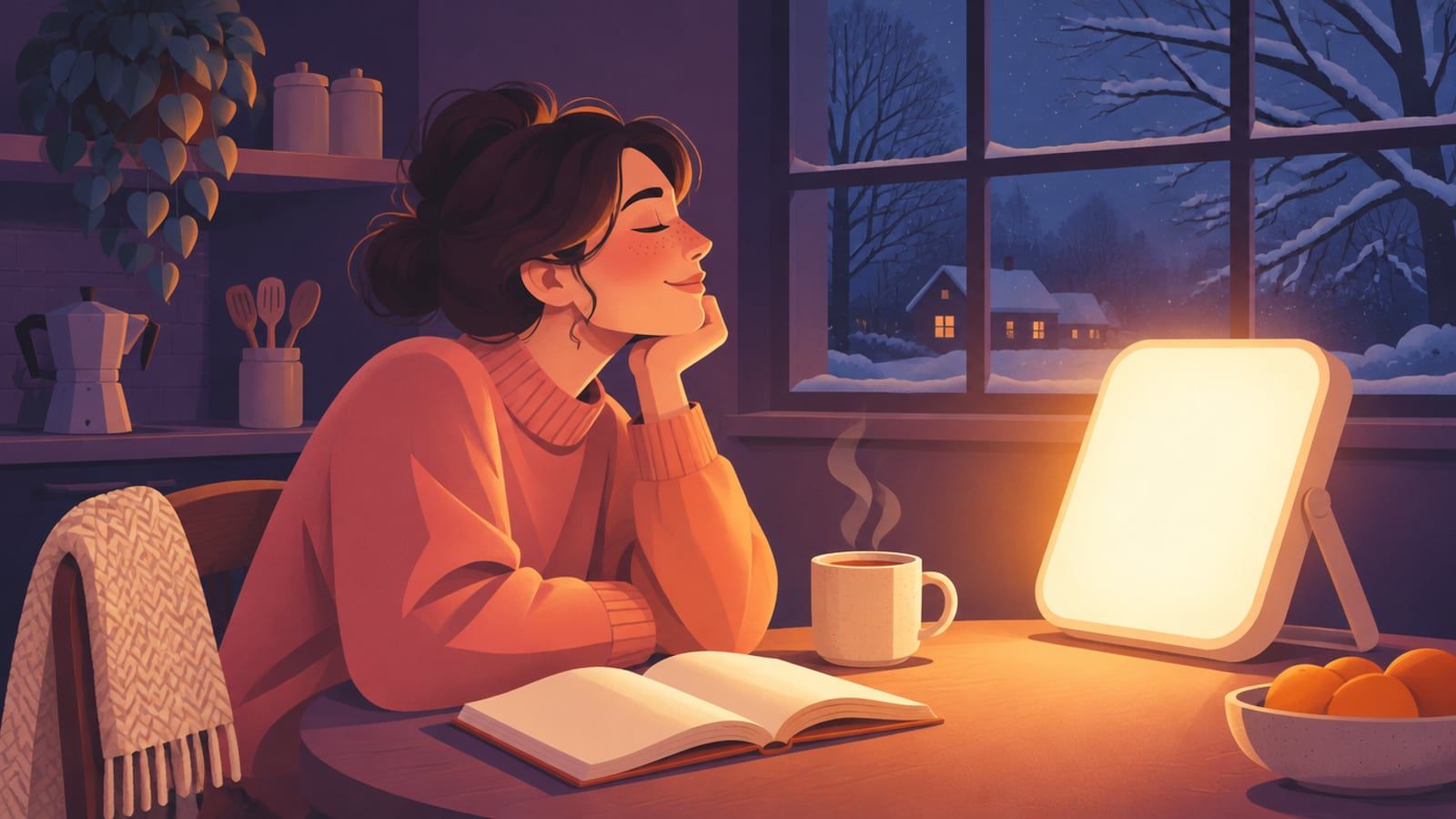
It is 6:20 on a Wednesday in the middle of November, and your alarm has been going for a full minute. Behind the blind, the window is the same flat black it was at midnight.
The light box you bought last winter sits on the shelf by the kitchen table. You used it on nine scattered mornings in January, whenever you remembered, propped at the far end of the table while you scrolled, and it did not seem to do much.
The short answer: A SAD lamp is a light box that delivers about 10,000 lux, roughly 20 times brighter than ordinary indoor light, and it is one of the first-line treatments for winter-pattern seasonal affective disorder. Use it within the first hour after waking, for about 20 to 30 minutes, at the distance the maker states (often 16 to 24 inches), with your eyes open but not staring into it, every day from autumn into spring. It usually starts working within a few days to a few weeks. If you have bipolar disorder, an eye condition or take medication that makes you sensitive to light, talk to a clinician before you start.
So last winter’s lamp may have been fine. Light therapy is a dose with four numbers attached (brightness, distance, minutes and timing), and nine scattered mornings never gave it a fair trial.
How does a SAD lamp work?
Your body clock runs slightly longer than 24 hours on average, so it has to be pulled back into line every day, and the daily cycle of light and darkness is the primary signal that does it (Duffy and Czeisler, Sleep Medicine Clinics, 2009).
Winter weakens that signal twice over: sunrise arrives late, often after your alarm, and much of the day happens indoors. A typical home interior delivers around 50 to 200 lux and an office 200 to 400, while an overcast day outdoors gives about 1,000 and a clear one 10,000 to 30,000 (Oldham, Oldham and Desan, Psychiatric Research and Clinical Practice, 2019). The kitchen only feels bright because your eyes adapt.
A SAD lamp closes part of that gap: 10,000 lux with the ultraviolet filtered out, about 20 times brighter than ordinary indoor light by NIMH’s estimate (NIMH), and more beside a dim living room. Why it lifts mood is not settled. One clue: in 42 people with SAD, Terman and colleagues found that morning light shifted body clocks earlier, evening light shifted them later, and the response to morning light grew with the size of the earlier shift (Archives of General Psychiatry, 2001).
Do SAD lamps actually work?
For SAD, yes, with caveats.
A meta-analysis found an effect size of 0.84 for bright light in SAD across eight randomised trials, comparable to most antidepressant drug trials, and an effect for dawn simulation, the gentler technique behind sunrise alarm clocks (Golden et al., American Journal of Psychiatry, 2005). Only 13 percent of the studies it screened met its quality bar, though.
In the Can-SAD trial, 96 people with winter depression got eight weeks of either 10,000-lux light for 30 minutes each morning with a placebo pill, or dim placebo light with the antidepressant fluoxetine. Both groups had a 67 percent response rate, and the light group improved faster in the first week, with less agitation and sleep disturbance (Lam et al., American Journal of Psychiatry, 2006).
A 2020 meta-analysis of 19 randomised trials still found light better than placebo, but with a more modest effect and a moderate-to-high risk of bias (Pjrek et al., Psychotherapy and Psychosomatics). Using a lamp to prevent SAD has thinner support: a Cochrane review found one small study and could draw no conclusion (Nussbaumer-Streit et al., 2019).
The milder winter blues have less research. In a Dutch trial of 48 people with sub-syndromal SAD, symptoms fell by about half within 15 days with either a 10,000-lux white lamp or a dim blue one (Meesters et al., BMC Psychiatry, 2016), but with no placebo group, that is a promising sign rather than proof. Mayo Clinic’s summary is fair: research is limited, but light therapy appears to relieve SAD symptoms for most people (Mayo Clinic).
What time of day should you use a SAD lamp?
Early, and at the same time every day. Mayo Clinic’s guidance is within the first hour of waking (Mayo Clinic), and a Cleveland Clinic psychologist warns that night use can disturb your sleep (Cleveland Clinic).
The Terman study shows why. In an expanded group of 80 patients, early morning light beat late morning and evening light, with the best timing about 2.5 hours after the midpoint of each person’s sleep. Sleep from 11 PM to 7 AM and that sweet spot lands around 5:30, earlier than most people care to be anywhere. So the practical rule collapses to “as soon as you can after you get up”, which makes a steady wake time part of the protocol.
How to use a SAD lamp: five rules for dark mornings
1. Measure the distance before you get comfortable
Lux describes what reaches your face, not the lamp, and it falls quickly as you lean back: in Oldham’s tests, a typical research-style box gave 12,000 lux at about 20 inches and 7,000 at about 28. Mayo Clinic’s typical range is 16 to 24 inches, but the maker’s stated distance wins. The guidelines Oldham’s team reprints even suggest a length of string to hold it, which sounds fussy until you notice how far you drift while reading.
2. Eyes open, lamp to the side
The light works through your eyes, so keep them open, but do not stare into it. Cleveland Clinic’s advice is to treat the lamp as a passive light source set off to the side, and the guidelines suggest raising it and angling it down to cut glare.
3. Start with 20 to 30 minutes
Mayo Clinic says about 20 to 30 minutes at 10,000 lux; a dimmer lamp needs longer. The right length is personal, so set it with a clinician rather than guessing.
4. Every day, weekends included, from autumn to spring
NIMH describes daily sessions from fall to spring, and the guidelines are blunt about weekends: no sleeping in, no skipping. They recommend four weeks of daily sessions before judging the result, because many people use the lamp on and off and conclude too early that it does not work.
5. Take real daylight when you can get it
Mayo Clinic notes that outdoor light helps even on cold or cloudy days, especially within two hours of getting up. A walk on a grey morning still beats your living room by a wide margin: about 1,000 lux against 50 to 200.
How are SAD lamps different from a regular lamp?
A regular lamp lights a room. A SAD lamp is built to put 10,000 lux on your face from a usable distance, through a diffuser, with ultraviolet filtered out, and plenty of products sold as light therapy lamps fall short. Of 24 devices Oldham’s team tested, only seven met three basic criteria: at least 7,000 lux at 12 inches or more, at least 5,000 lux six inches off center, and no harsh glare or hot spots. Some devices sold as 10,000-lux lamps reached that figure only at unreasonably close distances.
What to look for:
- The distance behind the number. A 10,000-lux claim without a distance tells you little; Oldham’s team advises clinicians to recommend only boxes that state it.
- A large, evenly lit panel. The big boxes held their brightness across a wide range of distances, while one smaller unit fell below 7,000 lux past 13.5 inches. Small boxes were also the likeliest to feel glaring.
- Made for SAD, with UV filtered. Some therapy lamps are made for skin conditions and mainly produce ultraviolet light, which Mayo Clinic warns could damage your eyes if used incorrectly.
- White light is enough. There is no evidence that blue-heavy light treats SAD better than adequate white light, and a lot of short-wavelength light may add risk to the retina.
And the FDA does not regulate light boxes for SAD, so the claims on the box are the maker’s own.
SAD lamp side effects, and who should ask a doctor first
Side effects are usually mild. Cleveland Clinic lists eye strain, headaches, fatigue, irritability and insomnia (Cleveland Clinic), and its psychologist cited above adds blurry vision and says to stop and call your provider if they appear. Ask a clinician before your first session if you have:
- Bipolar disorder. Bright light can trigger hypomania or mania, and Mayo Clinic warns that increasing exposure too fast or using the lamp too long may bring on manic symptoms.
- An eye condition, such as glaucoma, cataracts, macular degeneration or eye damage from diabetes.
- Medication that makes you light-sensitive, such as certain antibiotics and anti-inflammatories.
The guidelines Oldham’s team summarises go further: because of the risk that light activates manic or suicidal states, treatment belongs under a qualified clinician’s supervision. A lamp is also no substitute for a diagnosis. If you are sleeping far more than usual, pulling away from people or low most of the day for weeks, see a doctor, who may also check for lookalikes such as a thyroid problem. If you are having thoughts of suicide, call or text 988, the Suicide and Crisis Lifeline in the US.
Where WakeSharp fits (and where it doesn’t)
One unglamorous variable keeps coming back: the clock. The guidelines ask for a consistent start time each morning, and Mayo Clinic’s self-care advice for SAD asks for reliable times to wake up and go to bed. A session at 6:30 on Tuesday and 9:45 on Saturday lands at two different points in your biological morning, which is social jet lag with a lamp attached.
Holding the wake time steady is the part an alarm can help with. WakeSharp is an iPhone and Android alarm app where the alarm ends with a mission you choose, and one mission is about light. First Light asks you to walk to a window and hold your phone in the light, which gets you on your feet and into whatever daylight there is. On mornings when your alarm rings long before sunrise, a window has nothing to give, so pick a different mission for those, such as Walk It Off, which counts real steps, and end the walk at the lamp (switch a light on first).
The limits, plainly: WakeSharp is an alarm, not a light box and not a treatment. It has no sleep tracking, it cannot tell you whether what you feel is SAD, and finishing a mission says nothing about your mood. The lamp, the timing and your clinician do that work; the alarm just makes the same time every morning easier to keep.
FAQ
How long should you sit in front of a SAD lamp?
About 20 to 30 minutes at 10,000 lux, within the first hour after you wake, is the usual starting point. NIMH describes about 30 to 45 minutes, and the Can-SAD trial used 30. Agree the length with a clinician, since some people need more and some less.
Can you use a SAD lamp too much?
Yes: more is not better. Overdoing it, or using the lamp late in the day, can bring headaches, eye strain, irritability and trouble sleeping. Clinicians watch for hypomania and feeling revved up, especially in the first few days (Terman and Terman, CNS Spectrums, 2005). If you feel wired, agitated or unusually high, stop and call your clinician.
Can vitamin D help with seasonal depression?
Possibly, but the evidence is shakier than for light. Many people with winter-pattern SAD are low in vitamin D, and NIMH says supplements may help, but studies are mixed: some found vitamin D as effective as light therapy, others found no effect. A blood test and a talk with your doctor beat guessing at a dose.
Does light therapy work for anxiety?
The evidence is thin. A 2026 meta-analysis of recent trials in people with mental disorders found light therapy eased anxiety as well as depression (Wang et al., General Hospital Psychiatry), but anxiety was a secondary outcome, not the main target. If anxiety is the main problem, treat a lamp as a possible extra, not the treatment.
Tomorrow at 6:20
If the dark months flatten you year after year, start with a clinician, who can confirm it is SAD and help set the dose. Then make the lamp boring: at its stated 10,000-lux distance on the breakfast table, raised a little and angled down, switched on within an hour of your alarm, 20 to 30 minutes with your eyes open, Saturday included. If the heaviness outlasts a few weeks of honest use, go back to the clinician rather than shopping for a brighter lamp.
And if your clock runs late all year, not just in winter, becoming a morning person without hating your life covers the slower work.
- morning-light
- dark-mornings
- circadian-rhythm