
Sleep Science
Does Turkey Make You Sleepy? The Tryptophan Myth and the Real Food Coma
· 10 min read
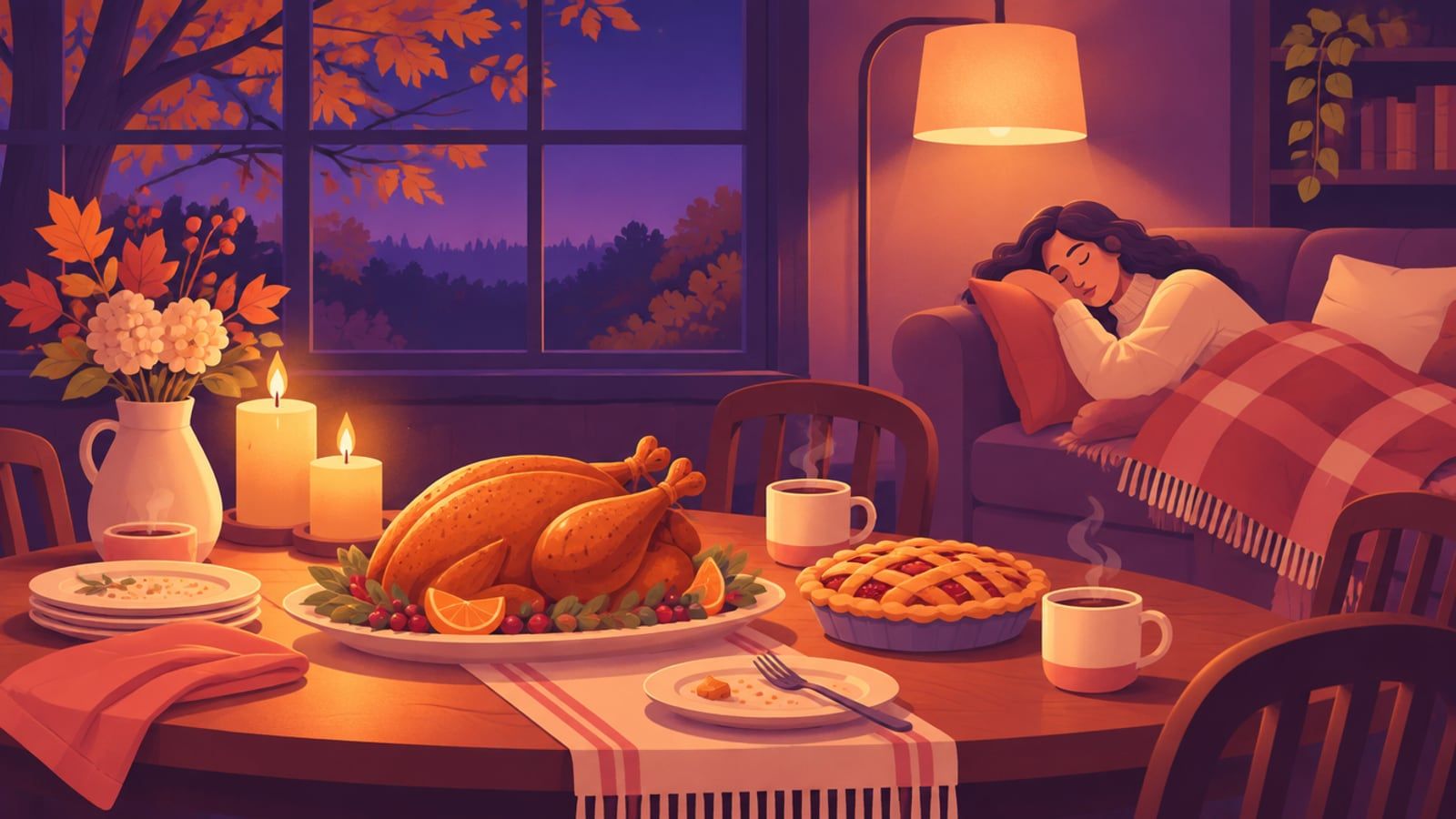
It is 4:45 on Thanksgiving afternoon. Dinner was at two. Since then you have put away turkey, more turkey, stuffing, two rolls, sweet potatoes under a lid of marshmallows, a glass and a half of red and a slice of pecan pie that was honestly closer to a slice and a half. The game is on with the sound low, and your eyelids have started making decisions without you.
From the armchair, your uncle delivers the diagnosis he delivers every year: it’s the tryptophan.
Your alarm for Friday is set for 5:30. Doorbusters, an early shift, a flight home: pick your reason. The uncle is wrong about the bird. He is right that the afternoon has a chemistry, though, and most of it is yours to adjust before the first plate.
The short answer: not really. Roasted turkey breast has almost exactly as much tryptophan as roasted chicken breast (about 0.36 g per 100 g of each, in USDA data), and in a protein-heavy meal very little extra of it reaches the brain. The Thanksgiving slump comes from the size of the meal, the alcohol beside it, the body clock’s mid-afternoon dip and the short night many people bring to the table. It usually peaks one to two hours after eating and passes within a few hours.
Does turkey make you sleepy? Run the numbers
Tryptophan itself is not the myth. The body uses it to make serotonin, a key brain messenger, and it plays a part in sleep, according to Harvard Health. The myth is that turkey is special.
USDA FoodData Central lists roasted turkey breast at 0.364 g of tryptophan per 100 g. Roasted chicken breast comes in at 0.362 g. That is a two-milligram difference, and Harvard Health likewise puts a serving of turkey on par with chicken, beef or salmon. Nobody blames a chicken sandwich for an afternoon nap.
Then there is the queue at the door. Tryptophan gets into the brain through a transporter it shares with other large neutral amino acids, notably tyrosine and the branched-chain amino acids, so when the branched-chain ones rise in the blood, tryptophan’s uptake falls (Fernstrom, Amino Acids, 2013). The same 100 g of turkey breast carries about 5.6 g of tyrosine and branched-chain amino acids, roughly fifteen times its tryptophan.
So protein-rich meals tend to lower the ratio that decides tryptophan’s share, and carbohydrate-rich meals tend to raise it. Testing ordinary American breakfasts, Wurtman and colleagues found the two kinds of meal left that ratio a median 54 percent apart, and only the carbohydrate breakfast raised insulin (American Journal of Clinical Nutrition, 2003). If anything on the table nudges your brain’s tryptophan up, it is more likely the rolls and the pie than the bird.
Purified tryptophan is a different animal. A 2022 meta-analysis in Nutrition Reviews found that tryptophan supplements shortened time spent awake during the night, especially at doses of a gram or more, while other sleep measures didn’t change. A capsule arrives without the crowd of competitors; a drumstick arrives with all of them. That is a finding about capsules in trials, not a shopping suggestion.
Why do I get so tired after Thanksgiving dinner?
The medical name for a food coma is postprandial somnolence. Cleveland Clinic describes it as a short-term rise in sleepiness and sluggishness that often starts 30 minutes to two hours after a meal and, in sleep tests, usually peaks one to two hours in. The old theory, that blood flows away from your brain after a meal, has been dropped. Current explanations involve signals from the gut, shifts in glucose and amino acids in the blood, and changes in the brain’s arousal pathways. On Thanksgiving, four things stack.
The size of the meal
The effect is stronger after larger, higher-energy meals. In one lab study, a solid meal made volunteers fall asleep faster in early-evening nap tests than the same volume of water did (Orr et al., Physiology and Behavior, 1997). Which nutrient matters most is genuinely unsettled: Orr’s high-fat, high-carbohydrate and mixed meals did not differ from one another, while another trial found a high-fat breakfast left people more fatigued three hours later than a high-carbohydrate one (Wells et al., 1997). Size is the lever the evidence agrees on.
The clock
Many people get sleepier in the mid-afternoon even when they have had no lunch and don’t know what time it is, a dip rooted in human biology rather than in the meal (Monk, Clinics in Sports Medicine, 2005). A high-carbohydrate lunch makes it worse. A two o’clock feast lands squarely on top of it.
The wine
People may fall asleep faster after drinking, but they sleep in fragments and tend to wake earlier, according to the NIAAA. On the couch at 4:45 you are feeling the first half of that deal. The second half is in what alcohol does to the rest of your night.
The night before
The post-lunch dip gets worse after a disturbed night’s sleep (Reyner et al., Physiology and Behavior, 2012), and holidays run on disturbed nights: the late drive, the air mattress, the cousin who arrives at midnight. Cleveland Clinic lists young adults who haven’t slept much, night-shift workers and people 65 and older among those at greater risk of a food coma.
The drive home is the risky part
On the couch, a food coma is harmless. Behind the wheel it is not. A British analysis of 679 sleep-related crashes found three daily peaks, around 2 AM, 6 AM and 4 PM (Horne and Reyner, BMJ, 1995). In Reyner’s driving-simulator study, young men who had slept five hours showed more sleepiness-related lane drifting after a 922-calorie lunch than after a 305-calorie one, with the gap opening after the first half hour of a monotonous drive.
Hand the keys to whoever skipped the second plate and the wine. If your eyes are heavy, Cleveland Clinic’s advice is blunt: don’t drive; pull over, take a short nap or wait until you’re alert. Keep that 6 AM peak in mind on Friday, too.
How do I avoid a food coma?
You can’t move the clock, but most of the rest is negotiable.
- Make the first plate the main event. Cleveland Clinic suggests smaller, balanced meals built on protein, fiber and lower-GI carbohydrates, and Harvard’s list starts with portion size. A modest first plate and a twenty-minute pause before seconds is easier than turning down pie.
- Walk after the meal. Cleveland Clinic suggests 10 to 30 minutes. In a 2022 meta-analysis, breaking up sitting with light walking blunted the rise in blood sugar and insulin after meals compared with staying seated. Whether a walk on its own prevents the slump is less studied, but it gets you off the couch before the dip settles in.
- Go easy on the wine, and stop early. It deepens the afternoon slump and breaks up the night that follows, and Friday collects on both.
- If you nap, keep it short and early. Mayo Clinic suggests 20 to 30 minutes and warns that napping after 3 PM can make night sleep harder. In a study of people who had slept five hours, a 10-minute nap helped right away, while a 30-minute nap brought a spell of grogginess first (Brooks and Lack, Sleep, 2006). Our nap timer has presets for 10, 20 and 30 minutes. If dinner ran late into the afternoon and Friday starts early, the walk is the better trade.
- Keep one wake time across all four days. A long weekend of late nights and lie-ins shifts your body clock later, like a short trip west, and Monday pays the fare. Getting up close to your usual time from Thursday to Sunday is cheap insurance.
- Count back from Friday’s alarm. A 5:30 alarm after a 1 AM bedtime is a four-and-a-half-hour night, whatever the turkey did. Pick Thursday’s bedtime before the pie, not after it.
The Friday alarm
The meal rarely wrecks the weekend. The 5:30 alarm on the far side of it does, in a guest room, after wine.
If WakeSharp is setting that alarm, the mission worth choosing is Walk It Off, which asks for real steps, counted by your phone. On this particular morning that is the point: the mission asks for walking, not negotiating. However you quiet the alarm, the morning only counts once the mission is done. Set it up on Thursday while you are still sharp, allow the motion permission it needs, and run a short test alarm. In a dark, unfamiliar house, switch on a light and walk carefully. First Light, which asks you to walk to a window and hold your phone in daylight, suits a later Saturday wake-up better than a pre-dawn Friday.
The honest limits: a mission can get you moving, but it can’t undo Thursday. WakeSharp doesn’t track your sleep, and no alarm, ours included, can promise you’ll wake up. If Thursday ran late and wet, the NIAAA notes that hangover symptoms peak as blood alcohol falls back to about zero, that attention, decision-making and coordination can all be impaired, and that nothing cures a hangover but time; coffee and a shower won’t. Walking to the kitchen is fine. Driving to a 6 AM sale may not be.
FAQ
What is a food coma?
“Food coma” is the everyday name for postprandial somnolence, the sleepy, sluggish stretch after a meal. It often starts within two hours of eating, peaks around one to two hours in, and usually passes within a few hours on its own. It is stronger after big, high-energy meals and after a short night, and worse when it lands on the body clock’s mid-afternoon dip.
Why does tryptophan make you sleepy?
Tryptophan is the raw material for serotonin, which the pineal gland turns into melatonin, a hormone that helps time the body’s daily rhythms (Tordjman et al., Current Neuropharmacology, 2017). As a purified supplement at a gram or more, it shortened time awake during the night in pooled trials. In food it competes with other amino acids to reach the brain, so a protein-rich meal like turkey does little to raise brain levels. If you are thinking about a supplement, talk to a clinician first, especially if you take other medicines.
Does turkey have more tryptophan than chicken?
No. USDA data put roasted turkey breast at 0.364 g of tryptophan per 100 g and roasted chicken breast at 0.362 g, and Harvard Health compares a turkey serving with chicken or beef. If turkey knocked people out, an ordinary Tuesday chicken dinner would too.
Why do I get tired after eating, even on ordinary days?
A mild dip after a big lunch is normal, especially after a short night. Cleveland Clinic suggests seeing a clinician for frequent or severe daytime sleepiness, loud snoring or pauses in breathing, dizziness or fainting after meals, shakiness, sweating or confusion a few hours after eating, or signs of diabetes such as thirst, frequent urination or blurred vision. Those deserve a proper look, not a new menu.
Blame the second plate, not the bird
Turkey is a respectable source of protein and a hopeless sedative. The Thanksgiving slump is a big meal eaten in the afternoon dip, washed down with wine, on top of a short night, and every one of those has a handle you can grab. Serve one honest plate, take the walk, stop the wine early, and set Friday’s alarm before the pie comes out.
Your uncle can keep the tryptophan theory. Like the good china, it only comes out once a year.
- long-weekend
- food
- circadian-rhythm