
Sleep Science
Why Do I Wake Up With a Headache? 9 Causes and What Helps
· 11 min read
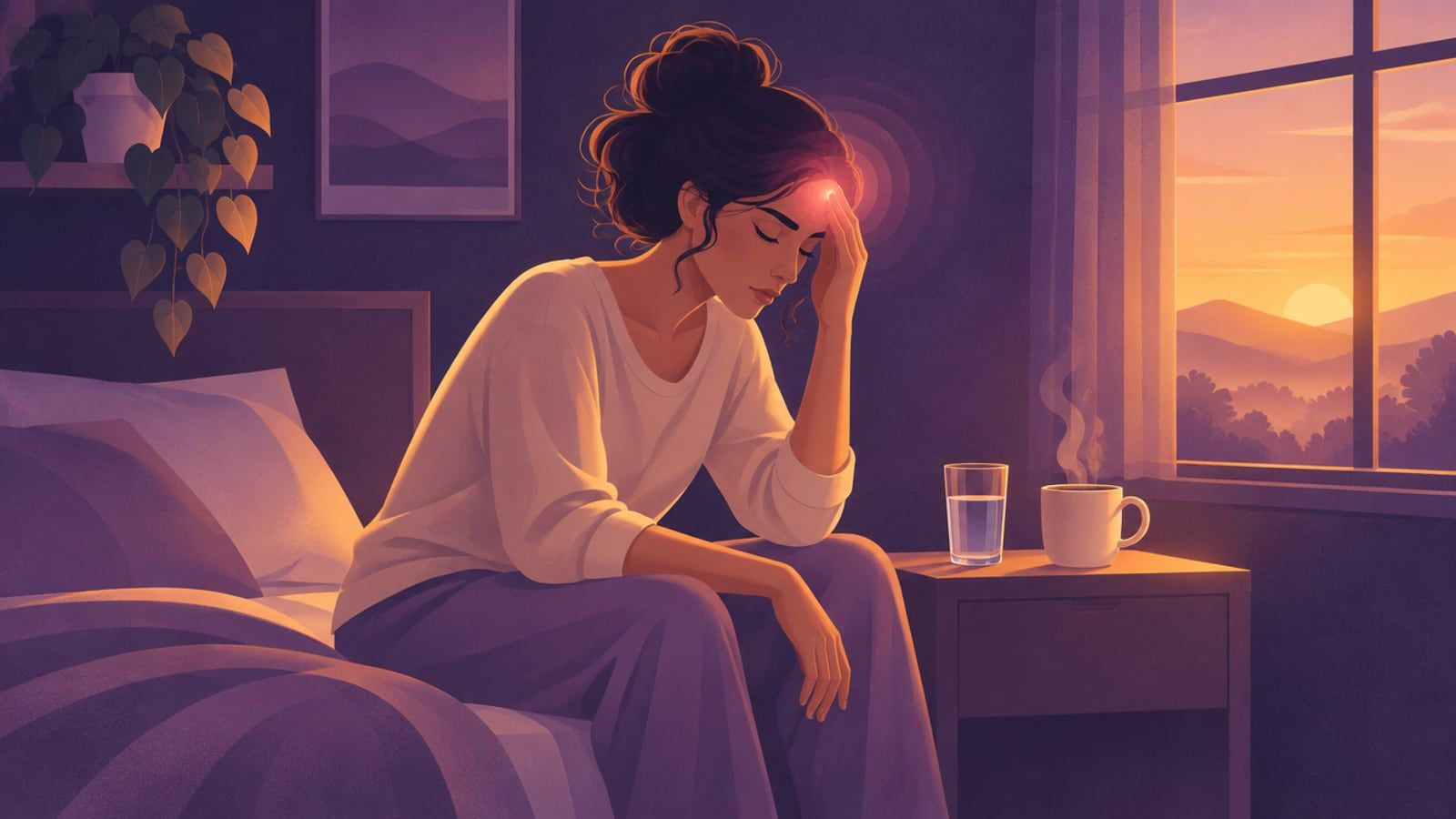
It is 9:52 on a Saturday and you have finally slept in, ten hours or so. The reward is a dull band across your forehead that throbs when you bend down for your slippers.
On weekdays the alarm goes at 6:30 and coffee follows at 7:00. Your last cup was at 3 PM yesterday, nearly 19 hours ago. Twenty minutes after this morning’s coffee the headache is gone, and you blame the lie-in.
You might be right. It might also be the coffee schedule, last night’s wine, or something you do asleep that only your partner knows about.
The short answer: the usual causes of a morning headache happen overnight: sleep that was too short, too long or later than usual, a longer gap than normal since your last caffeine, alcohol, teeth grinding, or breathing that keeps pausing (sleep apnea). About 1 in 13 people have recurring morning headaches, according to a survey of nearly 19,000. An occasional one usually has an ordinary explanation; frequent ones, or any with warning signs such as sudden severe pain, weakness or confusion, need a doctor.
Why the morning, of all times?
Sleep and headache share wiring. The brainstem, hypothalamus and thalamus help regulate both, which may be why disrupted sleep makes headache attacks more likely while sleep itself is one of the oldest known ways to end one (Holland, Cephalalgia, 2014). And a night is a long stretch without water, food or caffeine, spent in one position, with whatever your jaw and airway get up to.
A telephone survey of 18,980 people in five European countries found chronic morning headaches in 7.6 percent. The strongest links were anxiety and depression, insomnia and body-clock disorders; breathing problems in sleep, high blood pressure and heavy drinking were linked too, though morning headaches were not specific to breathing problems (Ohayon, Archives of Internal Medicine, 2004). A morning headache is often a sleep or mood signal as much as a head problem.
Waking up with a headache: the 9 usual causes
1. Sleeping in, or a wake time that wanders
The NHS headache advice includes not sleeping more than you usually would, because it can make the headache worse (NHS). In a study of 1,207 people with migraine, three in four reported triggers; among them, 32 percent named sleeping late and 57 percent named not eating, which a lie-in also postpones (Kelman, Cephalalgia, 2007). A wake time that swings by hours also drags your body clock around, the social jet lag problem in another costume. The clue: headaches that cluster on days off.
2. Too little sleep, or broken sleep
In a Norwegian population study of 15,268 adults who had no headaches at the start, people with insomnia were 40 percent more likely to have headaches 11 years later, and twice as likely to have migraine (HUNT study, Headache, 2011). Insomnia and depression were also among the strongest links in the European survey, so bad nights and low mood together are worth raising with a doctor.
3. Caffeine withdrawal (the late weekend coffee)
The international headache classification recognizes a caffeine-withdrawal headache that develops within 24 hours when a habit of more than 200 mg a day, kept for over two weeks, is interrupted or merely delayed; caffeine usually relieves it within an hour (ICHD-3). A review of 66 studies found headache in half of people in experimental withdrawal, with symptoms typically starting 12 to 24 hours after the last dose (Juliano and Griffiths, Psychopharmacology, 2004).
In a 1992 study of 151 headache clinic patients, those with both above-average caffeine intake and above-average weekend lie-ins had a 69 percent risk of weekend headaches, against 4 percent with only one of the two and zero with neither. Sleeping in alone was not a significant cause (Couturier et al., Cephalalgia, 1992). One small, old study, but it fits the pharmacology. The clue: a days-off headache that vanishes suspiciously fast after coffee.
4. Alcohol, and the dehydration that comes with it
A hangover headache, formally a delayed alcohol-induced headache, starts 5 to 12 hours after drinking and clears within 72 hours (ICHD-3). Alcohol suppresses vasopressin, the hormone that tells your kidneys to hold on to water, so you lose more fluid overnight, and it fragments sleep (NIAAA). The sleep damage is its own story: how alcohol rewrites your sleep.
Plain dehydration, without the alcohol, is a less certain suspect (more on that in the FAQ below).
5. Teeth grinding and jaw clenching
Grinding or clenching your teeth in your sleep can leave a dull headache that starts at the temples, with a sore jaw, face or neck and worn teeth (Mayo Clinic). You may not know you do it until a bed partner hears it or a dentist sees the wear. People who grind are more likely to snore and have sleep apnea, and caffeine, alcohol, smoking and stress raise the risk. A dentist is the right first stop.
6. Snoring and sleep apnea
In obstructive sleep apnea, breathing stops and starts during sleep; the NHS lists loud snoring, gasping or choking, daytime exhaustion and a morning headache among the signs (NHS). The classification’s sleep apnea headache is present on waking, usually on both sides of the head, gone within four hours, and resolves when the apnea is successfully treated (ICHD-3). In a 2023 study of 116 adults with sleep apnea, morning headaches fell from 53 to 16 percent after three months or more of positive airway pressure therapy such as CPAP, though without a comparison group (Seo et al., Scientific Reports, 2023).
7. Your neck and your pillow
The evidence here is thin, and the researchers say so. In a blinded trial of side sleepers, about 1 in 5 reported waking neck stiffness, headache or arm pain at least once in a week on their own pillow, and symptoms varied by pillow type (Gordon et al., Journal of Pain Research, 2010). A different pillow is a reasonable experiment, not a proven fix.
8. Medication overuse headache
Headache tablets, taken often enough, can cause more headaches. Medication overuse headache means headache on 15 or more days a month, in someone with an existing headache disorder, after more than three months of taking acute headache medicine on 10 or more days a month (15 or more for some drugs). More than half of people with headaches on 15 or more days a month have it, and most improve once the overuse stops (ICHD-3).
9. Hypnic headache, the rare “alarm clock” one
This one wakes you rather than greeting you: attacks that come only during sleep and wake you, on 10 or more days a month for over three months, lasting 15 minutes to four hours, usually starting after 50. Doctors first rule out sleep apnea, night-time high blood pressure, low blood sugar, medication overuse and problems inside the skull; oddly, caffeine is among the treatments that have worked in reported cases (ICHD-3). A 2025 review groups it with mostly rare headache disorders (Sebastianelli et al., The Journal of Headache and Pain, 2025).
When should I worry about a morning headache?
Most headaches are not a sign of anything serious, and this article is a guide, not a diagnosis. These patterns outrank everything above:
- Call 911 or your local emergency number for a sudden, explosive or worst-ever headache, or one with weakness or numbness, slurred speech, loss of or change in vision, confusion, trouble walking, a seizure, or a stiff neck with fever, or one after a head injury.
- Get seen the same day if headaches are new to you, especially if you are over 50; come with jaw pain when chewing, a tender scalp or vision problems; are set off by coughing, sneezing, bending or exercise; come with vomiting; or keep getting worse.
- Book an appointment if headaches are regularly worse in the morning, wake you from sleep, have changed in pattern, last more than a few days, or come with loud snoring and gasping.
These lists follow MedlinePlus and the NHS.
What helps: five fixes, cheapest first
- One wake time, seven days a week. Keep the days-off alarm close to the weekday one. It tackles the lie-in, late coffee, late breakfast and drifting body clock at once. If you are short on sleep, add it with an earlier bedtime, not a later alarm.
- A first-coffee time, too. On days off, have your first caffeine near your weekday time. To keep long lie-ins instead, shrink the habit slowly: withdrawal grows with the dose, and quitting abruptly can mean days of the same headache. Do not cover the gap with a later Friday coffee: our caffeine calculator estimates what is still in your system at bedtime, and the caffeine cutoff guide explains what that costs your sleep.
- A two-week headache diary, as the NHS suggests. Log your wake time, sleep, last and first caffeine, alcohol, painkillers, and when and where each headache hit. Days off only points to timing. Temples and a sore jaw point to grinding. Both sides, gone within hours and with snoring, points to a conversation about a sleep study.
- A witness. You cannot hear yourself snore, gasp or grind. Ask whoever shares your room, and ask your dentist about wear.
- A painkiller count. If headache tablets are creeping toward 10 days a month, tell a doctor before they become cause number 8.
Where WakeSharp fits (and where it doesn’t)
Most of this article ends at a doctor, a dentist or a diary. The first fix needs only follow-through, easy to promise on Friday and hard to deliver at 7:30 on Saturday, when a groggy, warm, very persuasive version of you gets the final say.
WakeSharp is built for that moment: an alarm app for iPhone and Android that asks for a short mission when the alarm rings. Give your weekday alarm repeat days that include the weekend, and choose Math Problems: you solve arithmetic, round by round, at a difficulty you pick and can try out while you are awake. However you quiet the alarm, the morning only counts once the mission is done. Saturday’s 7:30 becomes a plan you already made, not a question you answer half asleep.
The limits, plainly. WakeSharp cannot tell you why your head hurts. It does not measure your sleep, so it cannot spot apnea, grinding or a short night, and a finished mission is not a medical test. Your phone’s own controls always work: nothing stops you switching the phone off. And no alarm can guarantee that you wake up.
FAQ
Why do I wake up with a headache every morning?
A headache most mornings is worth a doctor’s visit; MedlinePlus lists headaches that are worse in the morning among the reasons to see a provider soon. Causes worth checking for a daily pattern include sleep apnea (especially with snoring and daytime sleepiness), nightly teeth grinding, medication overuse, and insomnia or depression, which were among the conditions most strongly tied to chronic morning headaches in the European survey. A mid-afternoon last coffee can also leave you inside caffeine withdrawal’s 12 to 24 hour window by morning.
Can oversleeping cause headaches?
It can, particularly if you get migraines: 32 percent of migraine patients who reported triggers in one large study named sleeping late, and the NHS advises against sleeping more than usual with a headache. But a lie-in also delays your coffee and breakfast, and in a small study of weekend headaches, sleeping in mattered only alongside a big caffeine habit. A steady wake time handles all three.
Can sleep apnea cause morning headaches?
Yes. Sleep apnea headache is a recognized type: present on waking, usually on both sides of the head, gone within four hours, and resolving with successful treatment. It tends to come with loud snoring, gasping at night and daytime exhaustion. In one study, morning headaches among people with sleep apnea fell from 53 to 16 percent with positive airway pressure therapy, so it is worth asking a doctor about a sleep study.
Can dehydration cause a headache when you wake up?
It can contribute, and alcohol makes overnight fluid loss more likely. About 1 in 10 people asked in an informal survey by London researchers described headaches from going without water that eased after drinking (Blau et al., Headache, 2004). But in a randomized trial, people with recurrent headaches who drank more water reported better quality of life without having fewer headache days (Spigt et al., Family Practice, 2012), so treat a glass of water as a sensible first step rather than a cure.
Start with Saturday
Most morning headaches are the night sending an itemized bill. Start with the cheapest line: one wake time and one first-coffee time, seven days a week, for two weeks, with the diary by the bed. If the pattern points at snoring, grinding, daily painkillers or headaches that wake you, you will know who to call. And if a headache ever arrives sudden and severe, skip the experiment and get help.
- headaches
- sleep-quality
- caffeine