
Tips & Tricks
The Best Alarm Sound to Wake Up To, According to Research
· 11 min read
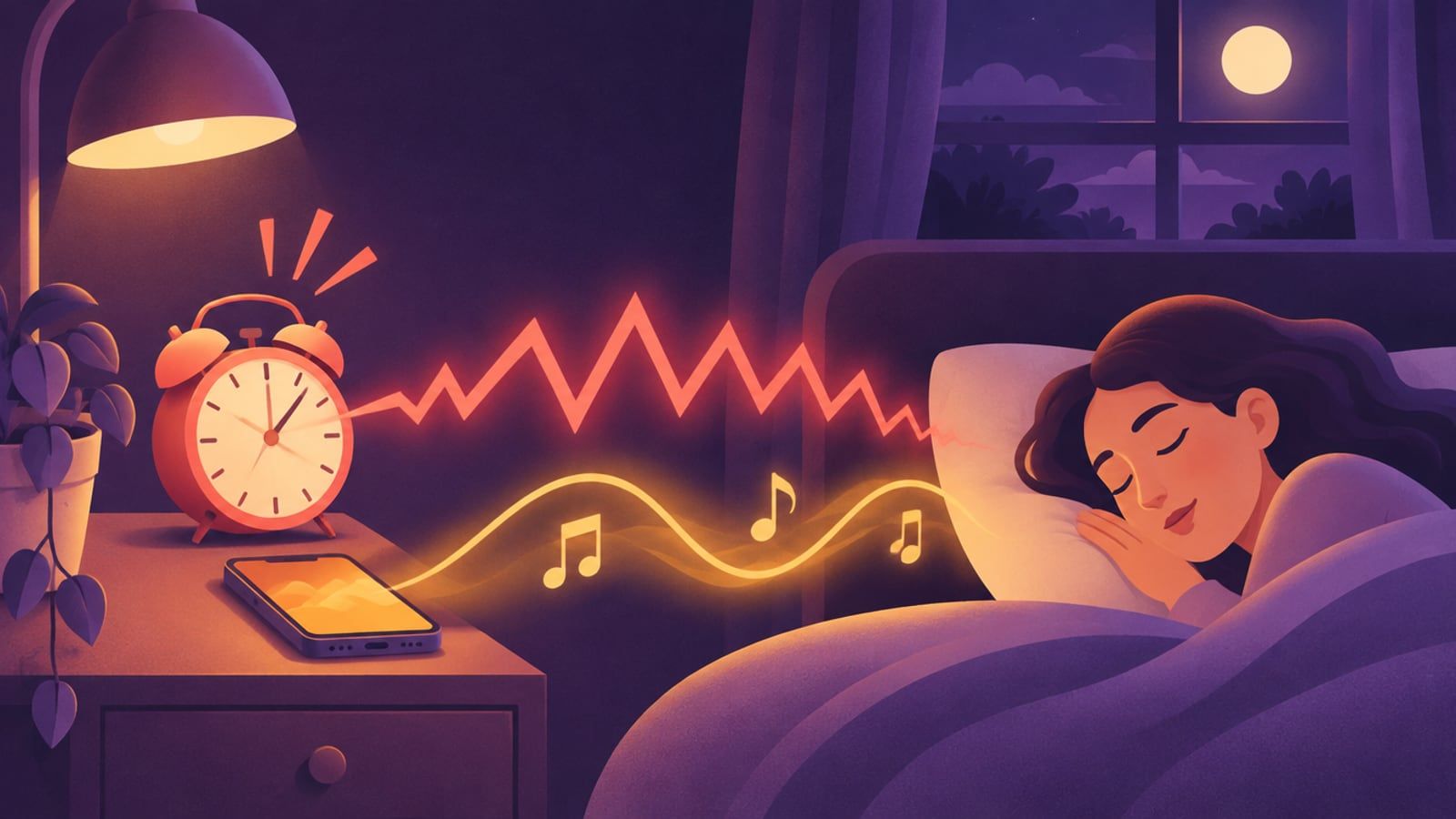
It is 6:40 on a dark Thursday in November, and the song you chose as your alarm in September starts to play. You picked it because it made you happy. This morning it slips into a dream as background music in a train station, and you only work out that it is coming from your nightstand when the chorus arrives, most of a minute later.
In September it worked on the first bar. The song has not changed. What has changed is that your sleeping brain has heard it on fifty-odd mornings, and nothing bad happened on any of them.
The short answer: the best alarm sound to wake up to is a low-pitched, buzzy tone rather than a thin, shrill beep, with a melody if your real problem is grogginess. In sleep-lab tests, a 520 Hz square-wave signal woke 92% of adults with hearing loss at 75 dBA, against 56% for a high-pitched smoke alarm at the same volume. Separately, a survey of 50 adults linked alarms they rated melodic with less morning grogginess. Whatever you choose, change it before it turns into background.
“Which alarm sound is best?” is really two questions: what gets through to a sleeping brain, and what you wake up well to. Only the first has solid research behind it.
What alarm sounds are best to wake up to?
The most careful work on this was done for a grimmer reason than oversleeping: people were dying in house fires despite a working smoke alarm. Dorothy Bruck and colleagues ran a series of sleep-lab studies on which signals wake people from deep sleep.
In one, 39 young adults slept in the lab over three nights while signals played during stage 4 sleep, the deepest stage, growing louder step by step until each sleeper woke (Bruck and colleagues, Journal of Sleep Research, 2009). The candidates included square waves, pure tones, whoops and white noise. The low-frequency square waves, at 400 and 520 Hz, woke people at significantly lower volumes than every alternative. A square wave is a single pitch carrying a stack of harmonics, which gives it a hoarse, buzzy edge, more doorbell buzzer than chime.
In another study, the team tested 38 adults with mild to moderately severe hearing loss (Bruck and Thomas, Ear and Hearing, 2009). At 75 dBA, the 520 Hz square wave woke 92% of them and the standard 3,100 Hz smoke alarm 56%. Bed and pillow shakers woke 80 to 84% at their out-of-the-box strength; strobe lights, 27%.
Two qualifications: the timing of the beeps mattered less than pitch, and these were deep-sleep experiments, the hardest case. The authors also suggested that the signal people notice most easily awake may be the most arousing one asleep, especially when the sleeper treats it as meaningful. Hold on to that last part.
Melodic or beeping: the grogginess question
Getting through is half the job. The other half is what you wake up into. Sleep inertia, the slowed, foggy state after waking, is measurably different from ordinary wakefulness, costs real performance, and is worst when you are woken during your biological night (Trotti, Sleep Medicine Reviews, 2017). More on that in our piece on sleep inertia.
In 2020, RMIT University researchers surveyed 50 adults within four hours of waking about their alarm and their grogginess (McFarlane and colleagues, PLOS ONE, 2020). The type of sound (tone, song, radio, nature sounds) made no significant difference. How melodic people rated it did: melodic sounds were over-represented among people who reported no grogginess at all, and sounds rated neither melodic nor unmelodic among those who reported it often.
A follow-up tested people at home with a reaction-time test straight after waking (McFarlane and colleagues, Clocks & Sleep, 2020). Ten people woke once to a plain, metronome-like pulse and once to the same pulse carrying a melody. With the melody they had fewer lapses and false starts, though the difference in average reaction time was not significant. Ten others heard the rhythm without the tune, and no measure changed significantly.
That is a promising lead from 70 people, not a settled result. The university’s press release went further, linking harsh tones to more grogginess (RMIT, 2020), but in the paper the tones rated unmelodic showed no significant link either way. And a gentle alarm sound is not a melodic one: gentle means soft, melodic means it has a tune, and the evidence points at the tune.
Why your favourite alarm stops working
A sleeping brain is still listening. A Lancet review of noise and health describes people perceiving, evaluating and reacting to sounds while asleep; whether a sound wakes you depends on its acoustics, how often it occurs, your sleep stage and your own sensitivity (Basner and colleagues, The Lancet, 2014). People tend to habituate to repeated noise, the review adds, to differing degrees and rarely completely.
That is the September song: heard every morning, never followed by anything that mattered. The sleeping brain’s sentinel mode points the same way from the other side. In 17 sleepers recorded with 256-channel EEG, the brain kept telling familiar voices from unfamiliar ones in every stage of sleep, REM included, and the unfamiliar voices drew the larger responses (Blume and colleagues, NeuroImage, 2018).
Being straight about the evidence: I could find no trial comparing one alarm tone kept for months against a rotation. The habituation findings come from environmental noise and the sentinel findings from voices, but they agree on the direction. Novelty earns attention; repetition without consequence loses it. A favourite song is a fragile choice: pleasant on purpose, often quiet at the start, and about to be taught that it does not matter.
Switching the alarm off with no memory of doing it is a different mechanism, covered in why you sleep through alarms you don’t remember dismissing.
How to pick an alarm sound that keeps working
1. Decide which problem you have
If you sleep through alarms, you need the sound to get through: pitch, placement, volume. If you hear it fine but spend half an hour in fog, you need a better landing: melody, light, getting upright. A louder tone does nothing for the second.
2. To get through, choose low and rough over thin and shrill
Preview tones and favour a lower, buzzier sound over a high, thin chirp. You want the family the 520 Hz square wave belongs to, not a lab replica. Prefer a clear start: a sound that fades in spends its first stretch at a volume you can sleep through.
3. For grogginess, try a tune
If you wake reliably but foggy, try a melodic alarm for two weeks, ideally a song you like rather than love. An iPhone alarm’s Sound can be a song, and Google’s Clock app can play one from YouTube Music, Pandora, Spotify or Calm, though a specific song usually needs a premium account (Google Clock Help). Heavy sleeper too? Set the melodic alarm first and a low, insistent backup a few minutes later. In Google’s Clock, leave at least five minutes between them: Google warns that the first of two alarms set too close together may be canceled.
4. Test it where you sleep
A tone that sounds brutal in your hand at 9 PM can be a murmur through a duvet across the room. Set a test alarm two minutes out, put the phone where it sleeps, lie down and listen. Then check the volume it will ring at: the iPhone steps are in the FAQ, and Google’s Clock keeps an Alarm volume slider and a Gradually increase volume option in its settings, under Alarms (Google Clock Help).
5. Change it before it goes stale
There is no tested interval, but swapping your main tone every few weeks, or alternating two, keeps it from settling into background. Change it at once if the first-week effect has worn off.
6. If you share a bed
Volume is a cost someone else pays. An Apple Watch alarm taps your wrist without sound when the watch is in Silent Mode (Apple). Touch works better than you might expect (bed and pillow shakers woke 80 to 84% in the hearing-loss study), but nobody tested a wrist tap there, so trial it on a morning that does not matter.
7. Know when the sound is not the problem
If you sleep through alarms after short nights, the fix is sleep, not a tone. In a lab study of ten men, the night after two nights of disrupted deep sleep took significantly louder tones to wake them, and thresholds fell as the night went on (Ferrara and colleagues, Clinical Neurophysiology, 1999). If you sleep through them despite full nights, or have persistent trouble waking, confusion on waking or heavy daytime sleepiness, raise it with a clinician: some sleep disorders, idiopathic hypersomnia among them, and mood disorders are linked with unusually hard waking (Trotti, 2017). And if you keep turning the alarm up, get your hearing checked.
The tone is the smaller half
WakeSharp is an alarm app, so it has a stake here, and its honest answer is that the tone is the smaller half.
Its sound picker lets you preview each tone before saving it to an alarm, and any tone pairs with any available mission. The library leans toward sounds built to get through: bells, quick digital beeps, a buzzer, a klaxon and sirens. On iPhone the tones are sorted into categories, including a Loud category for alarms that have to stand out. On iPhone, iOS controls the alarm volume, and a Loud tone does not override it; on Android, check the alarm volume and allow alarms in Do Not Disturb. If grogginess is your main complaint, a melodic first alarm from your phone’s own clock pairs fine with it.
The bigger limit is that no sound can guarantee you wake up. Habituation, sleep debt and a thumb that knows where the button is can beat any tone. So a WakeSharp alarm ends with a mission that takes more than a reflex: arithmetic with Math Problems, real steps with Walk It Off, or a walk to scan a real object with Scan an Object. However you quiet the alarm, the morning only counts once the mission is done. Your phone’s own controls always work: nothing stops you switching the phone off.
FAQ
Are melodic alarms better than beeping?
For grogginess, possibly. A 50-person survey linked melodic alarms with less reported grogginess, and in a 20-person follow-up a melody improved some measures of alertness while rhythm alone did not. For waking you at all, the stronger evidence favours low-pitched, buzzy beeps over shrill ones. If you need both, pair a melodic alarm with a low-pitched backup.
Why do I stop hearing my alarm?
Often habituation and sleep. A tone your brain has heard every morning without consequence can lose its claim on attention, and short sleep makes it worse, because deeper sleep takes a louder sound to break. Change the tone, move the phone farther away and look honestly at your bedtime. If the alarm might not have rung at all, check its volume and settings first.
Is it bad to wake up to a loud alarm?
There is little good evidence that it is. The worry traces mostly to a University of Virginia pilot of 32 people: after an alarm woke them following five hours of sleep, their morning blood pressure surge was 74% larger than after waking naturally, a 2.38 mmHg difference the researcher herself called small (UVA School of Nursing). That design cannot separate the alarm from the short night. The real costs are a woken partner and your hearing, since the louder a sound, the less time it takes to cause damage (CDC). Keep the speaker off your pillow, and if you have a heart condition, ask your doctor.
How do I turn up the alarm sound on my iPhone?
On iOS 27, open Settings, tap Sounds & Haptics, then under Alarms and Timers turn off Match Ringtone Volume and drag the alarm slider (or leave it on, so the alarm follows your ringtone volume). On iOS 26, alarms follow the Ringtone and Alerts slider (Apple). Change with Buttons lets the side buttons move it too, so a stray press can lower it. The rest is in our guide to a too-quiet iPhone alarm.
Tonight’s version
The best alarm tone for getting you up and the sound you wake well to are not always the same, and neither stays sharp forever. Pick low and buzzy if you sleep through alarms, a melody if you wake up foggy, both if you need both, and test them from your pillow tonight.
Then set a reminder for a few weeks out that says, simply, change the alarm. The September song deserves to go back to being a song.
- alarms
- sleep-inertia
- heavy-sleepers